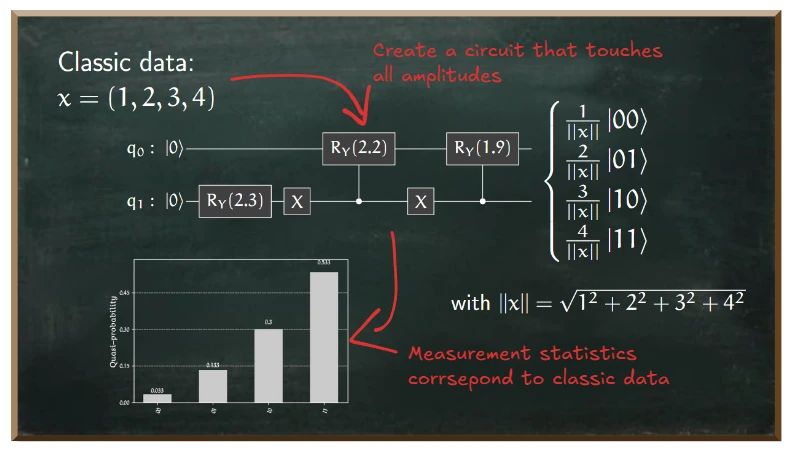
Amplitude encoding represents classical data as the amplitudes of a quantum state's basis vectors. If you have a normalized data vector , it’s encoded into an -qubit state . This allows data values to be stored in only qubits, but preparing the quantum state can be computationally expensive.
by Frank ZickertJanuary 8, 2026
Biggest Misconception:
Packing more data into fewer qubits leads to exponential speedup.
The reality is different. Data loading often involves significant costs of .
What Is Amplitude Encoding?
So, why is it useful?
Exponential compression: you put numbers into qubits
Enables quantum algorithms whose complexity depends on qubit count, not raw data size
Central to many Quantum Machine Learning is the field of research that combines principles from quantum computing with traditional machine learning to solve complex problems more efficiently than classical approaches. Learn more about Quantum Machine Learning proposals.
When do you want to use it?
Data is already Normalization in quantum computing means that the total probability of all possible outcomes of a quantum state must equal 1. Mathematically, if a quantum state is written as a vector of complex amplitudes, the sum of the squares of their magnitudes must be 1. This ensures that when the quantum state is measured, one of the possible outcomes will definitely occur. Learn more about Normalization or easy to normalize.
You need global vector operations (An inner product is a mathematical operation that takes two vectors and returns a single number measuring how similar or aligned they are. In Euclidean space, it’s the sum of the products of corresponding components (e.g., ). It generalizes the dot product and defines geometric concepts likelength and angle in vector spaces. Learn more about Inner Product norms).
You can reuse the prepared A quantum state is the complete mathematical description of a quantum system, containing all the information needed to predict measurement outcomes. It’s usually represented by a wavefunction or a state vector in a Hilbert space. The state defines probabilities, not certainties, for observable quantities like position, momentum, or spin. Learn more about Quantum State many times
This is typical in Quantum linear algebra (e.g., The HHL algorithm (Harrow–Hassidim–Lloyd) is a quantum algorithm for solving systems of linear equations exponentially faster than the best known classical methods, under certain conditions. It encodes the solution vector as a quantum state using phase estimation and controlled rotations based on the eigenvalues of . However, it only provides a quantum state proportional to , not its classical components, and its speedup depends on properties like sparsity and condition number of . Learn more about Harrow–Hassidim–Lloyd Algorithm), In machine learning, a **kernel** is a function that computes the similarity between data points in a higher-dimensional space without explicitly transforming the data there. This allows algorithms like Support Vector Machines to learn complex, nonlinear relationships efficiently. Essentially, it replaces inner products in feature space with a simpler computation in the original space. Learn more about Kernel methods and similarity estimation.
When NOT to use it?
You need to read out all components of the A vector is a mathematical object that has both magnitude (size) and direction. It’s often represented as an arrow or as an ordered list of numbers (components) that describe its position in space, such as . Vectors are used to represent quantities like velocity, force, or displacement. Learn more about Vector.
The dataset changes frequently.
On near-term (NISQ)Quantum hardware is the physical technology that builds and runs quantum computers, using quantum bits (qubits) instead of classical bits. These qubits exploit quantum properties like superposition and entanglement to process information in fundamentally different ways. The hardware can be based on systems such as superconducting circuits, trapped ions, or photons, each requiring extreme control and isolation to maintain quantum coherence. Learn more about Quantum Hardware with limited Circuit depth in quantum computing is the number of layers of quantum gates that must be applied sequentially, where gates acting on different qubits in parallel count as one layer. It measures how long a quantum computation takes, assuming gates in the same layer happen simultaneously. Lower depth is crucial because qubits lose coherence over time, so deep circuits are more error-prone. Learn more about Circuit Depth.
What are the limitations?
State preparation cost can be .
In quantum computing, measurement is the process of extracting classical information from a quantum state. It collapses a qubit’s superposition into one of its basis states (usually or ), with probabilities determined by the amplitudes of those states. After measurement, the qubit’s state becomes definite, destroying the original superposition. Learn more about Measurement bottleneck: In quantum computing an amplitude is a complex number that describes the weight of a basis state in a quantum superposition. The squared magnitude of an amplitude gives the probability of measuring that basis state. Amplitudes can interfere, this means adding or canceling, allowing quantum algorithms to bias outcomes toward correct solutions. Learn more about Amplitude are not directly observable.
Sensitive to Noise Learn more about Noise and gate errors.
Assumes access to an efficient An oracle is a black-box function that encodes information about a problem—typically deciding whether a given input satisfies some condition. It’s implemented as a quantum operation that can be queried in superposition, allowing a quantum algorithm to extract global properties of the function more efficiently than classical methods. Oracles are central to algorithms like Grover’s and Deutsch–Jozsa, where they guide the computation without revealing internal details. Learn more about Oracle or preparation circuit.
Beware of these common pitfalls!
Assuming amplitude encoding is free or automatic.
Ignoring Normalization in quantum computing means that the total probability of all possible outcomes of a quantum state must equal 1. Mathematically, if a quantum state is written as a vector of complex amplitudes, the sum of the squares of their magnitudes must be 1. This ensures that when the quantum state is measured, one of the possible outcomes will definitely occur. Learn more about Normalization constraints.
Forgetting that reading out data destroys the A quantum state is the complete mathematical description of a quantum system, containing all the information needed to predict measurement outcomes. It’s usually represented by a wavefunction or a state vector in a Hilbert space. The state defines probabilities, not certainties, for observable quantities like position, momentum, or spin. Learn more about Quantum State
Comparing A qubit is the basic unit of quantum information, representing a superposition of 0 and 1 states. Learn more about Quantum Bit count instead of total circuit cost.
How Does Amplitude Encoding Work?
High-level Idea
Start in .
Apply a A quantum circuit is a sequence of quantum gates applied to qubits, representing the operations in a quantum computation. Each gate changes the qubits’ state using quantum mechanics principles like superposition and entanglement. The final qubit states, when measured, yield the circuit’s computational result probabilistically. Learn more about Quantum Circuit that rotates In quantum computing an amplitude is a complex number that describes the weight of a basis state in a quantum superposition. The squared magnitude of an amplitude gives the probability of measuring that basis state. Amplitudes can interfere, this means adding or canceling, allowing quantum algorithms to bias outcomes toward correct solutions. Learn more about Amplitude so they match the data.
Use the resulting A quantum state is the complete mathematical description of a quantum system, containing all the information needed to predict measurement outcomes. It’s usually represented by a wavefunction or a state vector in a Hilbert space. The state defines probabilities, not certainties, for observable quantities like position, momentum, or spin. Learn more about Quantum State as input to a A quantum algorithm is a step-by-step computational procedure designed to run on a quantum computer, exploiting quantum phenomena such as superposition, entanglement, and interference to solve certain problems more efficiently than classical algorithms. Learn more about Quantum Algorithm
Most Important Parts
Normalization in quantum computing means that the total probability of all possible outcomes of a quantum state must equal 1. Mathematically, if a quantum state is written as a vector of complex amplitudes, the sum of the squares of their magnitudes must be 1. This ensures that when the quantum state is measured, one of the possible outcomes will definitely occur. Learn more about Normalization: Input vector must satisfy .
A basis state in quantum computing is one of the fundamental states that form the building blocks of a quantum system’s state space. For a single qubit, the basis states are and ; any other qubit state is a superposition of these. In systems with multiple qubits, basis states are all possible combinations of s and s (e.g., , , , and ), forming an orthonormal basis for the system’s Hilbert space. Learn more about Basis State: Each A quantum state is the complete mathematical description of a quantum system, containing all the information needed to predict measurement outcomes. It’s usually represented by a wavefunction or a state vector in a Hilbert space. The state defines probabilities, not certainties, for observable quantities like position, momentum, or spin. Learn more about Quantum State of the The computational basis is the standard set of basis states used to describe qubits in quantum computing. These are typically and for a single qubit. For multi-qubit systems all possible combinations of basis states denote the computational basis, like , , , and . These states correspond to classical bit strings and form an orthonormal basis for the system's Hilbert space. Any quantum state can be expressed as a superposition of these computational basis states. Learn more about Computational Basis corresponds to an index.
State preparation is the step where a quantum computer sets its qubits into a specific starting quantum state before running an algorithm. This is done using controlled operations (quantum gates) so the qubits represent exactly the probabilities and relationships the algorithm needs. If the initial state is wrong or noisy, the rest of the computation cannot give reliable results. Learn more about State PreparationA quantum circuit is a sequence of quantum gates applied to qubits, representing the operations in a quantum computation. Each gate changes the qubits’ state using quantum mechanics principles like superposition and entanglement. The final qubit states, when measured, yield the circuit’s computational result probabilistically. Learn more about Quantum Circuit: Often built from controlled rotations, recursive decomposition, and data-loading An oracle is a black-box function that encodes information about a problem—typically deciding whether a given input satisfies some condition. It’s implemented as a quantum operation that can be queried in superposition, allowing a quantum algorithm to extract global properties of the function more efficiently than classical methods. Oracles are central to algorithms like Grover’s and Deutsch–Jozsa, where they guide the computation without revealing internal details. Learn more about Oracle
How they contribute
Normalization in quantum computing means that the total probability of all possible outcomes of a quantum state must equal 1. Mathematically, if a quantum state is written as a vector of complex amplitudes, the sum of the squares of their magnitudes must be 1. This ensures that when the quantum state is measured, one of the possible outcomes will definitely occur. Learn more about Normalization ensures the A quantum state is the complete mathematical description of a quantum system, containing all the information needed to predict measurement outcomes. It’s usually represented by a wavefunction or a state vector in a Hilbert space. The state defines probabilities, not certainties, for observable quantities like position, momentum, or spin. Learn more about Quantum State are valid
A basis state in quantum computing is one of the fundamental states that form the building blocks of a quantum system’s state space. For a single qubit, the basis states are and ; any other qubit state is a superposition of these. In systems with multiple qubits, basis states are all possible combinations of s and s (e.g., , , , and ), forming an orthonormal basis for the system’s Hilbert space. Learn more about Basis State mapping defines how classical indices map to qubit states.
The State preparation is the step where a quantum computer sets its qubits into a specific starting quantum state before running an algorithm. This is done using controlled operations (quantum gates) so the qubits represent exactly the probabilities and relationships the algorithm needs. If the initial state is wrong or noisy, the rest of the computation cannot give reliable results. Learn more about State PreparationA quantum circuit is a sequence of quantum gates applied to qubits, representing the operations in a quantum computation. Each gate changes the qubits’ state using quantum mechanics principles like superposition and entanglement. The final qubit states, when measured, yield the circuit’s computational result probabilistically. Learn more about Quantum Circuit determines depth, error rate, and feasibility.
Use Cases
Quantum Machine Learning
Why it matters: Allows encoding large feature vectors compactly.
Why it fits: Many Quantum Machine Learning is the field of research that combines principles from quantum computing with traditional machine learning to solve complex problems more efficiently than classical approaches. Learn more about Quantum Machine Learning algorithms rely on An inner product is a mathematical operation that takes two vectors and returns a single number measuring how similar or aligned they are. In Euclidean space, it’s the sum of the products of corresponding components (e.g., ). It generalizes the dot product and defines geometric concepts likelength and angle in vector spaces. Learn more about Inner Product or distances.
Quantum Linear Systems
Why it matters: Potential exponential speedups in solving linear equations.
Why it fits: Inputs and outputs are vectors, not explicit numbers.
Kernel And Similarity Estimation
Why it matters: Fast comparison of high-dimensional data.
Why it fits: Overlaps can be estimated efficiently.
What It's NOT good for
Data retrieval tasks.
Classical preprocessing replacement.
Anything requiring full vector reconstruction.
Code Examples In Qiskit
? depicts the simplest way of Quantum Amplitude Encoding.
amplitude_encoding.py
1
2
3
4
5
6
7
8
9
10
11
12
13
14
15
16
from qiskit import QuantumCircuit
from qiskit.quantum_info import Statevector
import numpy as np
# Classical data
x = np.array([1, 2, 3, 4], dtype=float)
# Normalize
x = x / np.linalg.norm(x)
# Create statevector
state = Statevector(x)
# Build circuit that prepares this state
qc = QuantumCircuit(2)
qc.initialize(state.data, qc.qubits)
Listing 1 Amplitude encoding using Qiskit's initializeIn this code listing, we
the classic data as an NumPy is a Python library for working with large amounts of numerical data efficiently. It provides fast, memory-efficient arrays and tools for math operations like linear algebra, statistics, and matrix calculations. Learn more about Numpyarray
the vector to unit length: . This ensures the vector has magnitude , which is required for quantum state preparation.
the A quantum state vector is a mathematical object (usually denoted |ψ⟩) that fully describes the state of a quantum system. Its components give the probability amplitudes for finding the system in each possible basis state. The squared magnitude of each component gives the probability of measuring that corresponding outcome. Learn more about Quantum State Vector from the array of In quantum computing an amplitude is a complex number that describes the weight of a basis state in a quantum superposition. The squared magnitude of an amplitude gives the probability of measuring that basis state. Amplitudes can interfere, this means adding or canceling, allowing quantum algorithms to bias outcomes toward correct solutions. Learn more about Amplitude
the A quantum circuit is a sequence of quantum gates applied to qubits, representing the operations in a quantum computation. Each gate changes the qubits’ state using quantum mechanics principles like superposition and entanglement. The final qubit states, when measured, yield the circuit’s computational result probabilistically. Learn more about Quantum Circuit that prepares the corresponding A quantum state is the complete mathematical description of a quantum system, containing all the information needed to predict measurement outcomes. It’s usually represented by a wavefunction or a state vector in a Hilbert space. The state defines probabilities, not certainties, for observable quantities like position, momentum, or spin. Learn more about Quantum State
Note:
initialize is convenient but not efficient for large . Real algorithms replace this with structured preparation circuits.
Underlying Math And Equations
Encoding
Classical vector:
Quantum state:
Normalization constraint
Inner products
Quantum overlap:
Measurable via swap test or related circuits.
Complexity reality check
Worst case encoding cost:
Only useful if amortized over many operations.
Bottom Line
Amplitude encoding is powerful on paper but fragile in practice. Use it when State preparation is the step where a quantum computer sets its qubits into a specific starting quantum state before running an algorithm. This is done using controlled operations (quantum gates) so the qubits represent exactly the probabilities and relationships the algorithm needs. If the initial state is wrong or noisy, the rest of the computation cannot give reliable results. Learn more about State Preparation is cheap relative to what you do afterward, not because it saves A qubit is the basic unit of quantum information, representing a superposition of 0 and 1 states. Learn more about Quantum Bit.