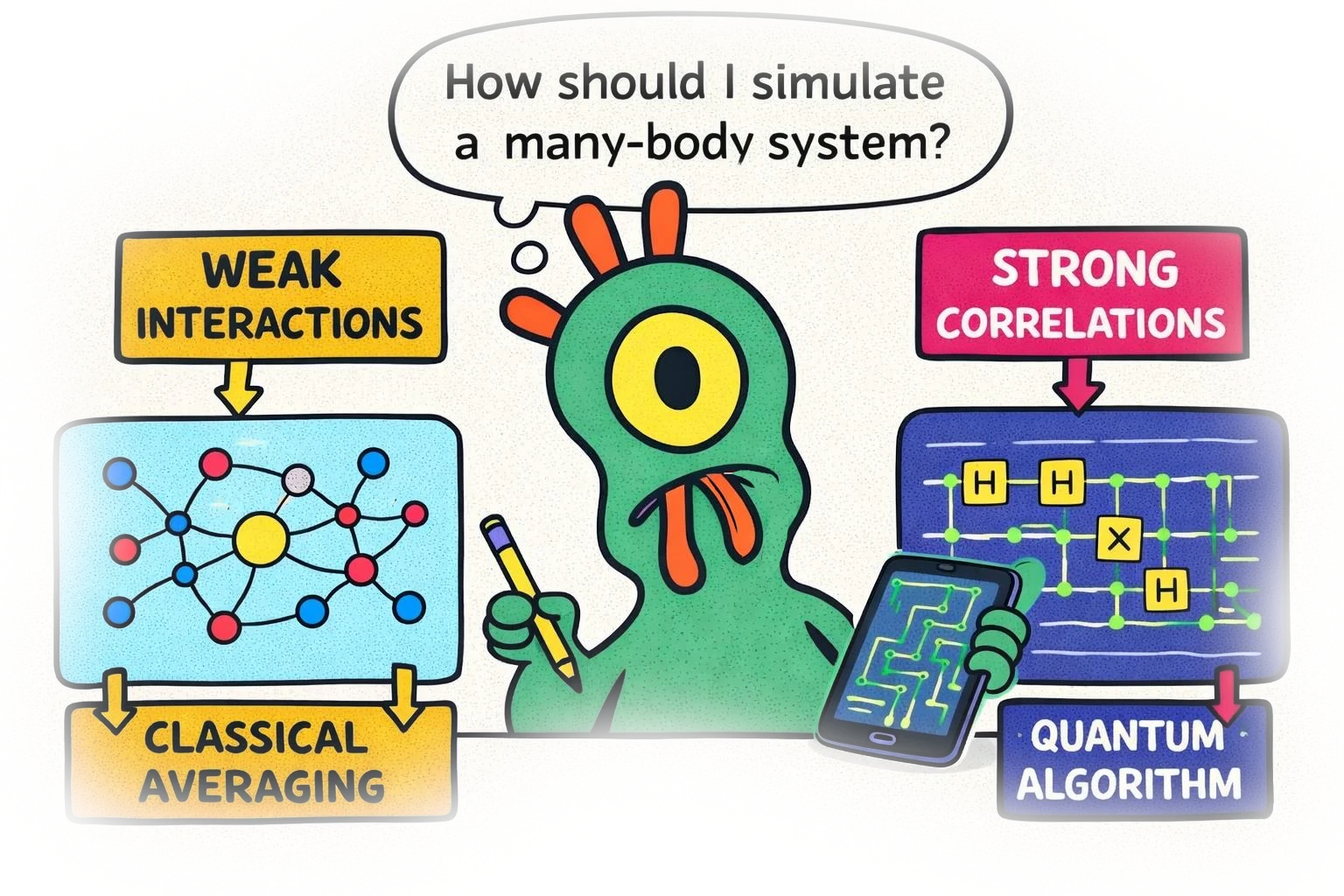
The analysis of a many-particle system involves simulating large groups of interacting particles, such as electrons in a molecule, where understanding the collective behavior of the particles is crucial. In quantum computing, these particles are mapped directly to qubits, enabling the precise modeling of complex chemical reactions and material properties that would otherwise be impossible to handle. The reason for this is that the complexity of these simulations increases exponentially with the size of the system and therefore quickly reaches classical limits.
by Frank ZickertFebruary 02, 2026
Imagine you are trying to simulate a new material for a battery or perhaps a complex molecule for a drug. You need to predict its properties, which depend entirely on how its electrons interact with each other. So what do you do? Of course, you run your simulation on a classical supercomputer. Because even though molecules are so small, they consist of an astonishing number of moving parts.
You add an electron to your model. The memory requirement doubles. You add another one. It doubles again. With a few dozen electrons, the memory requirements exceed the storage capacity of all hard drives on Earth. And we're not even talking about calculating how they behave.
This is not an error in your code. It is a fundamental limit of nature. To describe interacting particles, you must track a state space that scales with . You are encountering the limits of the many-particle problem.
This post is accompanied by a PDF file summarizing the key points.
Please Login to Download the PDF (your PyQML subscription works here!)
This is the study of the collective behavior of particle systems. Unfortunately, these cannot be understood by observing individual particles. Any attempt to replicate their collective behavior using digital logic will not be successful.
So what do you do?
The tried-and-true approach is to continue using approximation methods such as Density Functional Theory (DFT) is a practical way to predict a material’s electronic properties (like bonding, energies, and reaction behavior) by computing electron density instead of tracking every electron’s full quantum wavefunction. In quantum computing, DFT is mainly used to generate realistic molecules/materials and benchmark datasets, and to supply effective Hamiltonians and initial electronic structures that quantum algorithms (e.g., VQE) can refine toward more accurate energies for chemistry and materials design. This makes DFT a fast, scalable front-end for screening candidates, with quantum computers targeted at the hardest correlated-electron cases where DFT can struggle. Learn more about Density Functional Theory or Hartree–Fock is a fast classical method used to generate an approximate ground-state electronic structure—specifically a single “best” product state (Slater determinant) of orbitals. This provides a practical starting point for quantum chemistry workflows on quantum hardware: it supplies molecular orbitals and an initial state that can be prepared efficiently before applying quantum algorithms (e.g., VQE or phase estimation) to capture correlation beyond Hartree–Fock. It’s mainly valued because it reduces problem size and improves convergence by giving the quantum computer a good, physically motivated initial guess. Learn more about Hartree Fock These methods simplify the problem by averaging the particle interactions. They treat electrons as if they were moving through a static mean field rather than interacting dynamically.
And if the system you are studying has weak interactions, or if an approximate answer is sufficient, you should stick with these methods. They are inexpensive, stable, and well understood.
But what if the system you are interested in exhibits “strong correlations” between particles? Suppose you want to study high-temperature superconductors or chemical reactions in which bonds are broken. Then the mean-field approach eventually collapses like a house of cards.
You need a different way of addressing this problem. And this must cater to the specificities of Quantum mechanics is the branch of physics that describes the behavior of matter and energy at atomic and subatomic scales. Learn more about Quantum Mechanics The reason for this is simple. Essentially, the system you are investigating is subject to the laws of Quantum mechanics is the branch of physics that describes the behavior of matter and energy at atomic and subatomic scales. Learn more about Quantum Mechanics So it makes sense to simulate it with a A quantum computer is typically a large, highly controlled system kept at near-absolute-zero temperatures to preserve quantum behavior. It contains a processor with qubits—often made from superconducting circuits, trapped ions, or photons—manipulated by microwaves, lasers, or magnetic fields. Surrounding systems handle cooling, error correction, and control electronics to maintain quantum coherence and read out results. Learn more about Quantum Computer right?
However, choosing the quantum path brings new risks. It comes with its own set of challenges:
Decoherence is the process by which a quantum system loses its quantum behavior—like superposition—because it interacts with its surrounding environment. These interactions cause the system’s quantum states to become entangled with the environment, effectively destroying the system’s coherent phase relationships. As a result, the system starts to behave classically rather than quantum mechanically. Learn more about Decoherence You are limited by the coherence time of your hardware. If your simulation takes too long, your data will be destroyed by Noise Learn more about Noise
The barren plateau problem in quantum computing refers to regions in a quantum circuit’s parameter space where the **gradient of the cost function becomes exponentially small** as the number of qubits increases. This makes training variational quantum algorithms (like VQEs or QNNs) extremely difficult because optimization algorithms receive almost no useful signal to guide updates. It’s primarily caused by random circuit initialization and high circuit depth, leading to near-random output states. Learn more about Barren Plateau If you use variational algorithms to find solutions, the mathematical landscape can become completely flat. Your optimizer gets lost and is no longer able to find the solution
Connectivity: Your physical A qubit is the basic unit of quantum information, representing a superposition of 0 and 1 states. Learn more about Quantum Bit may not connect to each other in the same way as the electrons in your material. This forces you to use additional operations (SWAP gates), which cause more Noise Learn more about Noise
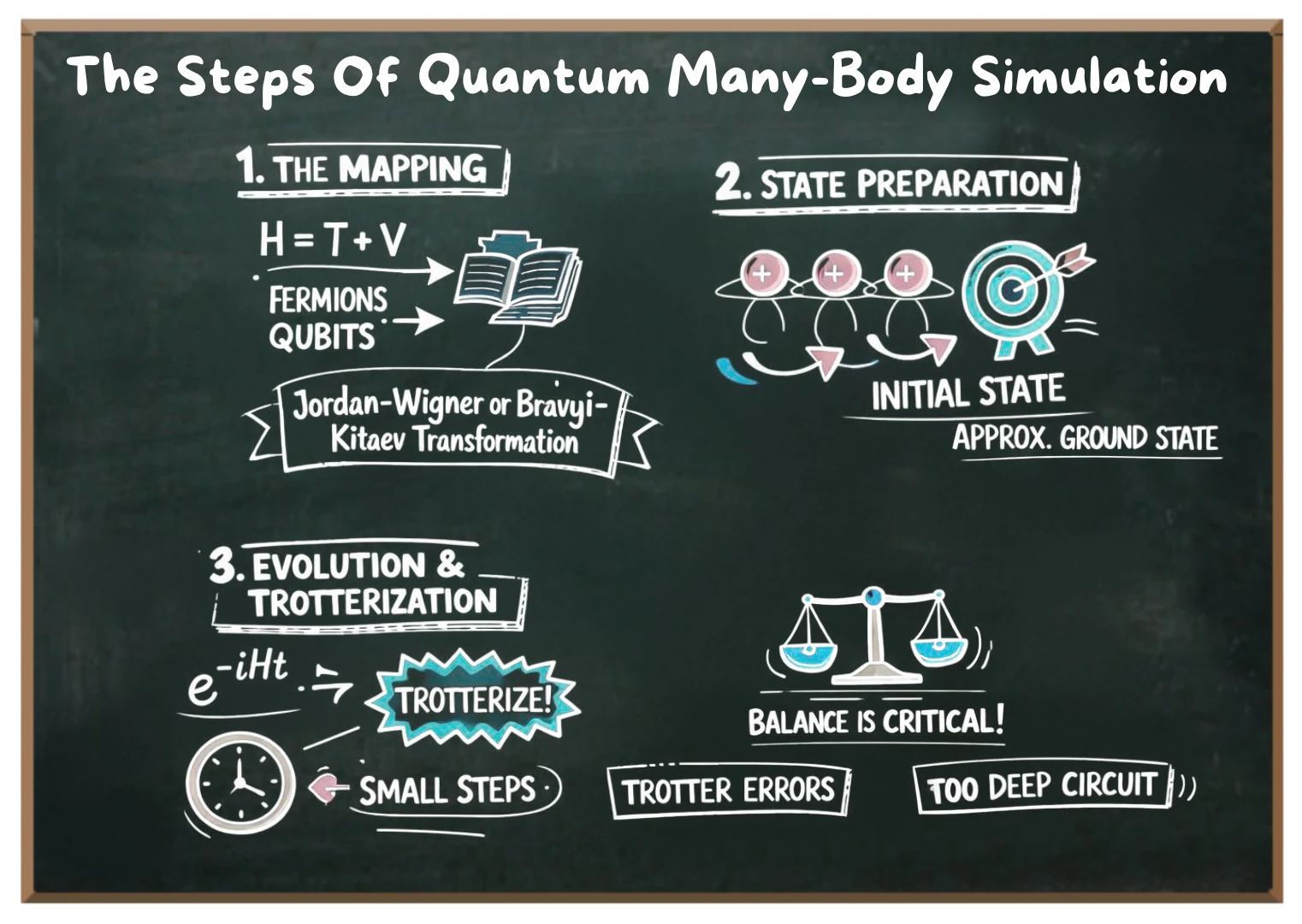
Let's assume you have decided to proceed with quantum many-body simulation. But don't say later that I didn't warn you about the risks. For it to work, you must actively manage three specific mechanisms. If one of them fails, your simulation is useless. ? depicts the steps of quantum many-body system simulation.
Join to continue
This part is available to PyQML researchers only. Log in or start a subscription to unlock member content.
Already a member? Use Log in. New here? Choose Subscribe.
Figure 1 Steps of quantum many-body system simulation
1. The mapping Your physical problem is described by a Hamilton operator. This is an operator that represents the total energy (kinetic and potential). In the physical world, the Hamiltonian describes fermions (electrons). However, your A quantum computer is typically a large, highly controlled system kept at near-absolute-zero temperatures to preserve quantum behavior. It contains a processor with qubits—often made from superconducting circuits, trapped ions, or photons—manipulated by microwaves, lasers, or magnetic fields. Surrounding systems handle cooling, error correction, and control electronics to maintain quantum coherence and read out results. Learn more about Quantum Computer speaks in A qubit is the basic unit of quantum information, representing a superposition of 0 and 1 states. Learn more about Quantum BitSo you need a translator.
You must use a transformation tool such as Jordan-Wigner or Bravyi-Kitaev. These algorithms mathematically convert the behavior of electrons into strings of Pauli gates (X, Y, Z) that your hardware can execute.
2. State preparation You can't start from nothing. You have to initialize your A qubit is the basic unit of quantum information, representing a superposition of 0 and 1 states. Learn more about Quantum Bit to an initial state that resembles the system under investigation, usually a simplified approximation of the ground state.
3. Evolution and Trotterization is a method to approximate the evolution of a quantum system whose Hamiltonian is a sum of non-commuting parts. It breaks the total evolution into a sequence of smaller steps , which can be implemented with available quantum gates. The smaller the time step , the closer the approximation is to the true evolution. Learn more about Trotterization From there on, you need to see how the system evolves over time according to Schrödinger’s equation describes how the quantum state (wavefunction) of a physical system changes over time. It’s the fundamental equation of quantum mechanics, playing a role similar to Newton’s laws in classical physics. The equation links the wavefunction’s curvature (its spatial behavior) to the system’s energy, determining the probabilities of measurable outcomes. Learn more about Schrödinger's EquationThis is done using the operator . The problem is that the different parts of the Hamilton operator (such as motion and interaction) do not commute. But you cannot apply them all at the same time, either.
You have to use Trotterization is a method to approximate the evolution of a quantum system whose Hamiltonian is a sum of non-commuting parts. It breaks the total evolution into a sequence of smaller steps , which can be implemented with available quantum gates. The smaller the time step , the closer the approximation is to the true evolution. Learn more about Trotterization. This involves dividing the continuous time evolution into tiny, discrete sequential steps. However, this has a disadvantage. If your steps are too large, you will cause Trotter Errors and the physics will be incorrect. If your steps are too small, the circuit will become too deep and hardware Noise Learn more about Noise will interfere with the computation. You need to find the right balance.
? depicts a minimum implementation of a many-body simulation using Qiskit is an open-source Python framework for programming and simulating quantum computers. It lets users create quantum circuits, run them on real quantum hardware or simulators, and analyze the results. Essentially, it bridges high-level quantum algorithms with low-level hardware execution. Learn more about Qiskit.
many_body_system.py
1
2
3
4
5
6
7
8
9
10
11
12
13
14
15
16
17
18
19
20
21
22
23
24
25
26
27
28
29
30
31
32
33
34
35
36
37
38
import numpy as np
from qiskit import QuantumCircuit
from qiskit.circuit import Parameter
from qiskit.quantum_info import SparsePauliOp
from qiskit.primitives import StatevectorEstimator
from scipy.optimize import minimize
# 1. The Hamiltonian (The Problem)
# Modeling a simple Ising chain: H = -ZZ - X0 - X1
H = SparsePauliOp.from_list([("ZZ", -1), ("XI", -1), ("IX", -1)])
# 2. The Ansatz (The Quantum Circuit)
# We manually define a parameterized circuit to explore the Hilbert space
qc = QuantumCircuit(2)
theta = [Parameter("θ0"), Parameter("θ1")]
qc.ry(theta[0], 0)
qc.ry(theta[1], 1)
qc.cz(0, 1) # Entanglement
# 3. The Manual Optimization Loop (The Execution)
estimator = StatevectorEstimator()
defcost_function(params):
# In V2, we pass a "pub" (Primitive Unified Bloc): (circuit, observable, params)
pub = (qc, H, params)
job = estimator.run([pub])
result = job.result()
# Extract the expectation value (energy)
return result[0].data.evs
# Use a classical optimizer to minimize the cost function
print(f"Ground State Energy: {opt_result.fun:.4f}")
print(f"Optimal Parameters: {opt_result.x}")
Listing 1 Simple many-body simulation
This code listing consists of five parts:
Defining the Physics (The Hamiltonian)
Building the Ansatz (The Trial State)
Setting up the Estimator
The Cost Function and Execution
The Classical Optimization Loop
We start with . The object H represents the problem you are trying to solve. In a many-body simulation, you cannot simply tell the computer simulate these electrons. You must map their interactions to A quantum gate is a basic operation that changes the state of one or more qubits, similar to how a logic gate operates on bits in classical computing. It uses unitary transformations, meaning it preserves the total probability (the state’s length in complex space). Quantum gates enable superposition and entanglement, allowing quantum computers to perform computations that classical ones cannot efficiently replicate. Learn more about Quantum Gate. The ZZ term represents the correlation between neighbors, while the X terms represent external magnetic fields acting on individual particles.
The The Hamiltonian operator () in quantum mechanics represents the total energy of a system — both kinetic and potential. It acts on a wavefunction to determine how the system evolves over time, according to the Schrödinger equation. Mathematically, , where is the kinetic energy operator and is the potential energy operator. Learn more about Hamiltonian Operator translates the physical description of your system (energy forces) into a language the A quantum computer is typically a large, highly controlled system kept at near-absolute-zero temperatures to preserve quantum behavior. It contains a processor with qubits—often made from superconducting circuits, trapped ions, or photons—manipulated by microwaves, lasers, or magnetic fields. Surrounding systems handle cooling, error correction, and control electronics to maintain quantum coherence and read out results. Learn more about Quantum Computer understands: A Pauli operator is one of three 2×2 complex matrices — **σₓ, σᵧ, σ_z** — that represent the basic quantum spin operations on a single qubit. They correspond to rotations or measurements along the x, y, and z axes of the Bloch sphere. Together with the identity matrix, they form a basis for all single-qubit operations in quantum mechanics. Learn more about Pauli Operator Specifically, it creates a A quantum operator is a mathematical object that represents a physical action or measurement on a quantum state. It transforms one quantum state into another, often expressed as a matrix acting on a vector in Hilbert space. In quantum computing, operators correspond to quantum gates, which manipulate qubits according to the rules of linear algebra and quantum mechanics. Learn more about Quantum Operator composed of interaction terms (ZZ) and transverse field terms (XI, IX).
In the next block, known as An Ansatz is a chosen form or structure of a quantum state (often parameterized) used as a starting point for algorithms like the Variational Quantum Eigensolver. It defines how qubits are entangled and rotated, and its parameters are optimized to approximate the solution to a problem. The quality of the Ansatz directly affects the accuracy and efficiency of the computation. Learn more about Ansatz. It constructs a A **Parameterized Quantum Circuit (PQC)** is a quantum circuit where certain gate operations depend on adjustable parameters—typically real numbers representing rotation angles. These parameters are tuned (often by classical optimization) to perform a specific task, such as minimizing a cost function. PQCs are central to **variational quantum algorithms**, where quantum computation provides state preparation and measurement, and a classical computer optimizes the parameters. Learn more about Parameterized Quantum Circuit that consistst of rotation gates (ry) with tunable angles (theta) on each A qubit is the basic unit of quantum information, representing a superposition of 0 and 1 states. Learn more about Quantum Bit, followed by an entangling gate (A controlled-Z (CZ) gate is a two-qubit quantum gate that flips the phase of the second qubit (adds a minus sign) only if the first qubit is in the state . In matrix form, it leaves , , and unchanged, but turns into . It’s mainly used to create entanglement between qubits, just like the CNOT gate but with a phase flip instead of a bit flip. Learn more about Controlled Z Gate).
This serves as your guess for the system's The **ground state** is the lowest possible energy state of a physical system, such as an atom or molecule. In this state, all particles occupy the lowest available energy levels allowed by quantum mechanics. Any higher-energy state is called an excited state. Learn more about Ground State Because the A Hilbert space is a complete vector space equipped with an inner product, which allows for measuring angles and lengths between vectors. "Complete" means that every Cauchy sequence of vectors converges to a vector within the space. It generalizes the idea of Euclidean space to possibly infinite dimensions and forms the foundation for quantum mechanics and functional analysis. Learn more about Hilbert Space is exponentially large, you cannot search every possible state. Instead, you create a circuit that can generate many states (depending on the angle of theta) and use Entanglement is a quantum phenomenon where two or more particles become correlated so that measuring one instantly determines the state of the other, no matter how far apart they are. This correlation arises because their quantum states are linked as a single system, not as independent parts. It doesn’t allow faster-than-light communication but shows that quantum systems can share information in ways classical physics can’t explain. Learn more about Entanglement (A controlled-Z (CZ) gate is a two-qubit quantum gate that flips the phase of the second qubit (adds a minus sign) only if the first qubit is in the state . In matrix form, it leaves , , and unchanged, but turns into . It’s mainly used to create entanglement between qubits, just like the CNOT gate but with a phase flip instead of a bit flip. Learn more about Controlled Z Gate) to capture the correlations between particles that classical computers struggle to model.
Next, we by initializing the specific Qiskit is an open-source Python framework for programming and simulating quantum computers. It lets users create quantum circuits, run them on real quantum hardware or simulators, and analyze the results. Essentially, it bridges high-level quantum algorithms with low-level hardware execution. Learn more about Qiskit Primitive. This will calculateThe expectation value is the average result you'd get if you repeated a measurement of a quantity many times under identical conditions. Mathematically, it’s the weighted average of all possible outcomes, where each outcome is weighted by its probability. In quantum mechanics, it represents the average value of an observable calculated from the wavefunction. Learn more about Expectation Value This specific version (StatevectorEstimator) uses precise Linear algebra is the branch of mathematics that studies vectors, vector spaces, and linear transformations between them. It provides tools for solving systems of linear equations and understanding geometric operations like rotations, projections, and scaling. Its core objects—matrices and vectors—form the basis for much of modern computation, physics, and machine learning. Learn more about Linear Algebra (ideal simulation) rather than sampling shots (noisy simulation). In a real scenario, you would swap this for a hardware-based estimator.
The three distinct elements into a Primitive Unified Bloc (PUB):
your circuit (the state)
your In quantum computing, a Hamiltonian is the operator (think “energy rulebook”) that determines how a quantum system evolves over time and which states are energetically favored. Practically, you define or engineer a Hamiltonian so that evolving the system (or finding its lowest-energy state) performs a computation—e.g., simulating molecules/materials or solving optimization problems by encoding the answer in the ground state. Quantum algorithms like Hamiltonian simulation and variational/annealing methods use the Hamiltonian as the central object to implement and control the computation. Learn more about Hamiltonian (the In quantum computing, measurement is the process of extracting classical information from a quantum state. It collapses a qubit’s superposition into one of its basis states (usually or ), with probabilities determined by the amplitudes of those states. After measurement, the qubit’s state becomes definite, destroying the original superposition. Learn more about Measurement
and your current parameters (the settings)
We use this function to run the job and extract the energy value (The expectation value is the average result you'd get if you repeated a measurement of a quantity many times under identical conditions. Mathematically, it’s the weighted average of all possible outcomes, where each outcome is weighted by its probability. In quantum mechanics, it represents the average value of an observable calculated from the wavefunction. Learn more about Expectation Value). This function bridges the gap between the quantum and classical worlds. It asks the A quantum computer is typically a large, highly controlled system kept at near-absolute-zero temperatures to preserve quantum behavior. It contains a processor with qubits—often made from superconducting circuits, trapped ions, or photons—manipulated by microwaves, lasers, or magnetic fields. Surrounding systems handle cooling, error correction, and control electronics to maintain quantum coherence and read out results. Learn more about Quantum Computer "If I rotate the A qubit is the basic unit of quantum information, representing a superposition of 0 and 1 states. Learn more about Quantum Bit by these angles, what is the energy of the system?" The result is a single number that tells us how close we are to the true ground state.
Finally, a classical Optimization is the process of finding the best possible solution to a problem within given constraints. It involves adjusting variables to minimize or maximize an objective function, such as cost, time, or efficiency. In simple terms, it’s about achieving the most effective outcome with the least waste or effort. Learn more about Optimization algorithm (COBYLA) to repeatedly call the cost_function. It tweaks the parameters (theta) based on the previous energy results, trying to find the lowest possible value.
The A quantum computer is typically a large, highly controlled system kept at near-absolute-zero temperatures to preserve quantum behavior. It contains a processor with qubits—often made from superconducting circuits, trapped ions, or photons—manipulated by microwaves, lasers, or magnetic fields. Surrounding systems handle cooling, error correction, and control electronics to maintain quantum coherence and read out results. Learn more about Quantum Computer generates the state and measures energy, but it doesn't know how to improve it. This classical loop acts as the manager, navigating the Optimization is the process of finding the best possible solution to a problem within given constraints. It involves adjusting variables to minimize or maximize an objective function, such as cost, time, or efficiency. In simple terms, it’s about achieving the most effective outcome with the least waste or effort. Learn more about Optimization landscape to find the solution. If this landscape is too flat (a The barren plateau problem in quantum computing refers to regions in a quantum circuit’s parameter space where the **gradient of the cost function becomes exponentially small** as the number of qubits increases. This makes training variational quantum algorithms (like VQEs or QNNs) extremely difficult because optimization algorithms receive almost no useful signal to guide updates. It’s primarily caused by random circuit initialization and high circuit depth, leading to near-random output states. Learn more about Barren Plateau), this function will fail to converge.
This code demonstrates the hybrid nature of many-body simulations. You define the Physics (Block 1) and a Trial State (Block 2). You then enter a loop where a Classical Optimizer (Block 5) drives a Quantum Estimator (Block 3 and 4) to find the configuration of A qubit is the basic unit of quantum information, representing a superposition of 0 and 1 states. Learn more about Quantum Bit that minimizes the total energy of the system.
When you run this code, you'll get the output depicted in ?:
1
2
Ground State Energy: -1.6180
Optimal Parameters: [0.55348219 0.55366175]
Listing 2 Output of the many-body simulation
It tells us the lowest energy level the simulated system can have and the correspding parameter values.
Many-body simulations apply to a range of practical use cases:
Materials Design (High-Temperature Superconductors): Understanding how electron repulsion leads to superconductivity requires treating the system as a true many-body problem, which is hard for classical supercomputers.
Pharmaceutical Drug Discovery: Accurate calculation of binding energies involves strong electron correlations in molecular orbitals. It reduces the failure rate of drugs in clinical trials by predicting efficacy earlier.
Nuclear Physics: Simulating the binding energy of atomic nuclei involves calculating the strong force interactions between many nucleons. This is essential for understanding stellar nucleosynthesis and fusion energy Dumitrescu, E.F., 2018, Physical Review Letters, Vol. 120, pp. 210501.