Quantum Application Development Is Taught The Wrong Way
This is why you won't learn it in the usual textbooks
It is not because you were not intelligent enough. But if your goal is to develop quantum algorithms, you should approach quantum computing from the problem side, not from physics.

Let's face it: the usual textbooks on quantum computing won't teach you how to develop quantum algorithms.
Read that again.
However, this is not because you were not intelligent enough. There are other reasons for this: The usual textbooks and online courses on quantum computing
- are crammed with technical physics jargon,
- use mathematical equations that confuse rather than clarify, and
- teach objects before purpose.
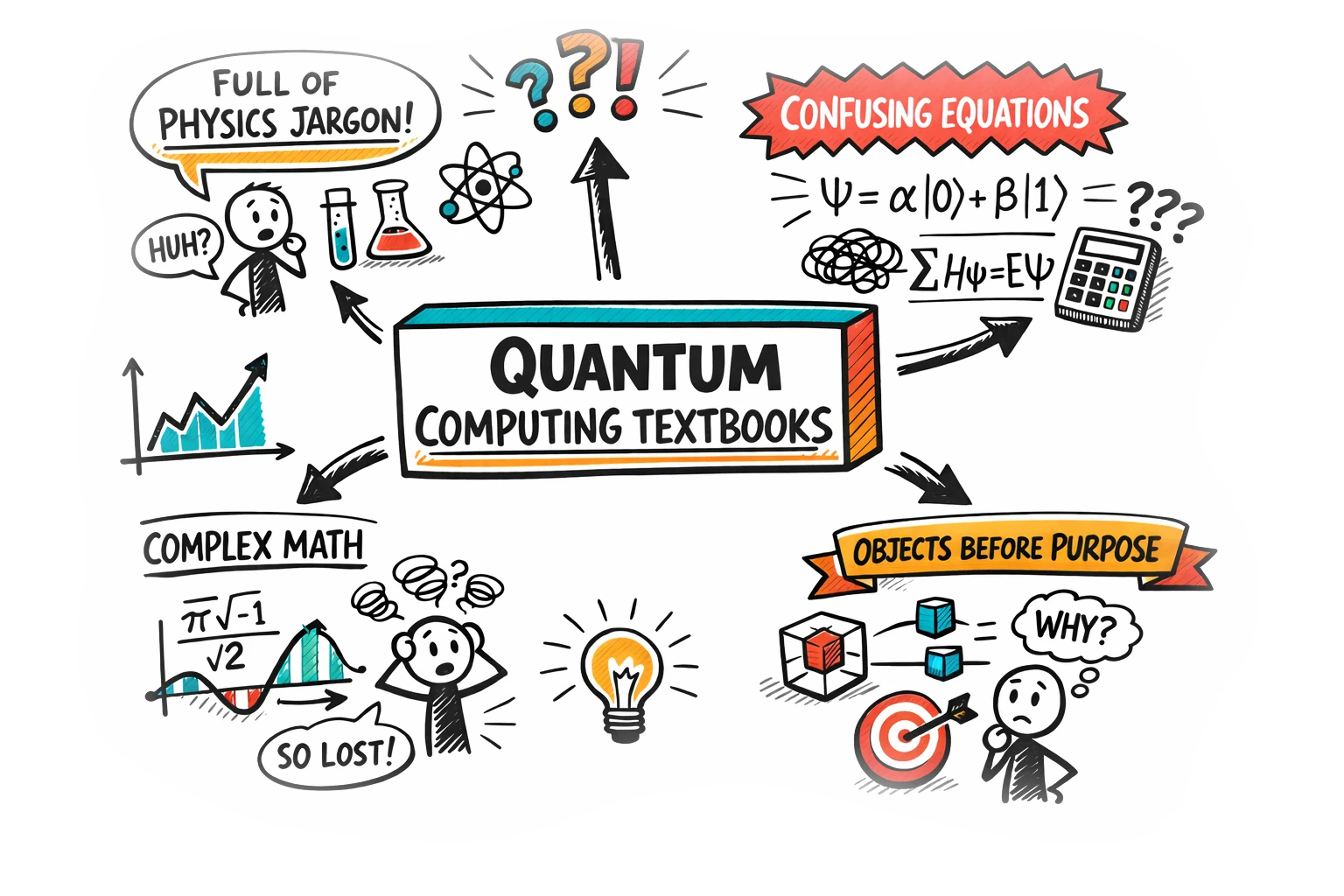
The Physics Jargon
Take, for example, this explanation of the Variational Quantum Eigensolver.
There are only two possibilities.
Either you understand what it says. Congratulations, you are already an expert in the field of quantum computing and need no further instruction. At least not the entry-level textbooks.
Or you don't understand it. And that's exactly the point! The usual explanations in quantum textbooks are incomprehensible. This makes them useless for beginners. Especially if your goal is not to become a physicist, but to develop quantum applications that solve real-world problems.
Such explanations are only useful for experienced physicists. But they don't need them because they are already experts.
Unfortunately, this type of description is not an exception or a rare case. No, it is the blunt rule.
An equation is not an explanation

When a textbook presents an unfamiliar equation, no one simply reads it. Reading an equation requires effort: deciphering symbols, recalling rules, guessing meanings, and reconstructing the question that the equation is supposed to answer.
If you cannot or do not want to do this work, the equation teaches you nothing. It blocks you.
This is important because equations are a compressed language. They only communicate with readers who already know what is compressed. Without prior intuition, an equation is like a zip file without a decompression program. All the information is technically there, but it is inaccessible to you.
Take quantum superposition, for example.
If you already know this equation by heart, it becomes a reference. A synonym, if you will. You no longer go through it. You recognize it and remember your conceptual understanding of quantum superposition.
But if you don't know it. If you're not familiar with the Dirac notation () used, or if you're not used to working with vectors, then this equation is as good as Egyptian hieroglyphics.
The usual textbooks often reverse the order of teaching. They introduce the equation first and suggest that understanding will then follow automatically. In practice, the opposite is true: understanding must come first. The equation should come last, as a precise summary of an idea that you have understood informally.
But when this order is reversed, learning becomes reverse engineering. You are forced to figure out the author's mental model without guidance. This is not teaching, but a puzzle disguised as teaching.
That's why we find unexplained equations more exhausting than enlightening. They place a high cognitive load on us without immediately providing any benefit and without allowing us to check whether our interpretation is correct. You might think you're bad at math, even though the real failure is pedagogical in nature. And that's not your fault. It's the author's fault!
Equations are powerful tools. But only for certain tasks. They ensure precision, enable calculations, and condense meanings. None of these functions are helpful if the meaning has not been constructed beforehand.
So, an unexplained equation is not knowledge. It is not an explanation. It is homework.
Too much technical jargon and unexplained equations are bad. But now it's getting ugly.
The false assumption behind most quantum computing education
Most materials on quantum computing are based on a single, usually unspoken assumption: If you understand the physical objects well enough, the algorithms will make sense.
This assumption is wrong.
For example, you are shown what a qubit is before you are told what you do with it. You are told how it differs from a classical bit. You are taught about superposition. But there is no guiding question that ties the details together. You memorize properties without knowing which ones are important.
Knowing how qubits behave as physical systems does not explain where quantum advantage comes from. The leap from physical behavior to algorithmic structure does not happen automatically. It must be taught.

Physics answers questions such as What can this system do? But when developing algorithms, another question matters: how do we arrange steps to exploit those capabilities to solve a problem?
Confusing these two terms leads to a gap in the learning process. You get explanations of qubits, gates, and measurements, then suddenly shown a complete algorithm and told, Now it should be clear. However, it usually isn't.
The problem lies in the levels of explanation. Physical descriptions operate at the component level. But algorithms operate at the strategy level. Mastering the components does not reveal any more about the strategy than understanding transistors explains why quicksort works.
As a result, you have no choice but to try to reverse engineer the intent. You see circuits and equations, but you can't answer fundamental questions: Why this sequence of gates? What problem structure is being exploited? What would break if we changed this step?
Good algorithm teaching works the other way around. It starts with the computational problem, identifies the bottleneck in classical approaches, and only then introduces the physical or mathematical features that eliminate this bottleneck.
When education assumes that physics automatically implies algorithms, it skips the most important step: explaining how physical effects are converted into computational leverage. This missing bridge is why so much teaching in the field of quantum computing seems opaque. Without an explicit algorithmic narrative, physics remains interesting but sluggish, and algorithms remain mysterious.
A different way to study quantum computing
However, there is no rule that says quantum computing must be taught using physics jargon, incomprehensible equations, and components.
Here is the crucial mistake you should avoid: Don't study quantum computing as applied physics if your goal is to develop algorithms.
Study it as algorithm design according to new rules.
Start with problems, not particles.
And ask yourself:
- What task do I want to accelerate or enable?
- Where do classical algorithms fail or reach their limits?
- What capability would eliminate this bottleneck?
Only then should you introduce quantum concepts. And only use those that are relevant to this ability.
Superposition is not interesting because it is strange physics. It is interesting because it enables an algorithm to represent many possible solutions simultaneously.
Interference is not interesting because of the wave metaphors. It is interesting because it enables an algorithm to reinforce good answers and eliminate bad ones.
Entanglement is not interesting because it violates classical intuition. It is interesting because it creates correlations that no classical data structure can store efficiently.
When taught in this way, quantum mechanics becomes more of a toolbox than a religion that one must live by. You learn concepts only as needed when an algorithm requires them, and you immediately understand why they exist.
Equations still appear. But only after the idea is clear. And they are well-explained. Physics is still important. But only where it offers computational advantages.
Algorithms are taught in every mature field. But we don't teach sorting by starting with transistor physics. So, we shouldn't teach quantum algorithms by starting with Hilbert spaces.
If your goal is to develop quantum algorithms, you should approach quantum computing from the problem side, not from physics.