Understanding The Problem Is The Most Important Part Toward Quantum Advantage
Why quantum advantage has nothing to do with speed
Quantum computers don’t win by running faster; they win by asking fewer, better-defined questions. But until you specify exactly what information an algorithm is allowed to access, any claim of quantum advantage is just hand-waving.
by Frank ZickertDecember 30, 2025
The hype surrounding A quantum computer is typically a large, highly controlled system kept at near-absolute-zero temperatures to preserve quantum behavior. It contains a processor with qubits—often made from superconducting circuits, trapped ions, or photons—manipulated by microwaves, lasers, or magnetic fields. Surrounding systems handle cooling, error correction, and control electronics to maintain quantum coherence and read out results. Learn more about Quantum Computer promises revolutionary speeds. You've been told that A quantum computer is typically a large, highly controlled system kept at near-absolute-zero temperatures to preserve quantum behavior. It contains a processor with qubits—often made from superconducting circuits, trapped ions, or photons—manipulated by microwaves, lasers, or magnetic fields. Surrounding systems handle cooling, error correction, and control electronics to maintain quantum coherence and read out results. Learn more about Quantum Computer are faster. But that's not true.
If you only look at clock speed, Quantum hardware is the physical technology that builds and runs quantum computers, using quantum bits (qubits) instead of classical bits. These qubits exploit quantum properties like superposition and entanglement to process information in fundamentally different ways. The hardware can be based on systems such as superconducting circuits, trapped ions, or photons, each requiring extreme control and isolation to maintain quantum coherence. Learn more about Quantum Hardware is slow. Much slower than classical chips.
Clock speed is not where the promise of Quantum Computing is a different kind of computation that builds upon the phenomena of Quantum Mechanics. Learn more about Quantum Computing lies.
Fortunately, it is not. This is because some problems become exponentially more difficult as they grow in size. The number of steps required to solve them grows exponentially with the size of the problem. Once this happens, no amount of speed increase would help. Ever. So if A quantum computer is typically a large, highly controlled system kept at near-absolute-zero temperatures to preserve quantum behavior. It contains a processor with qubits—often made from superconducting circuits, trapped ions, or photons—manipulated by microwaves, lasers, or magnetic fields. Surrounding systems handle cooling, error correction, and control electronics to maintain quantum coherence and read out results. Learn more about Quantum Computer were designed to speed up classical calculations, they would not help us at all with these problems.
Instead, the promise of Quantum Computing is a different kind of computation that builds upon the phenomena of Quantum Mechanics. Learn more about Quantum Computing lies in solving problems in ways that classical computers never could. It's about solving them with fewer steps. Ideally, exponentially fewer.
This raises an uncomfortable but necessary question.
What is a step?
What counts as a step
To answer this question, we use an abstraction called an An oracle is a black-box function that encodes information about a problem—typically deciding whether a given input satisfies some condition. It’s implemented as a quantum operation that can be queried in superposition, allowing a quantum algorithm to extract global properties of the function more efficiently than classical methods. Oracles are central to algorithms like Grover’s and Deutsch–Jozsa, where they guide the computation without revealing internal details. Learn more about Oracle.
An An oracle is a black-box function that encodes information about a problem—typically deciding whether a given input satisfies some condition. It’s implemented as a quantum operation that can be queried in superposition, allowing a quantum algorithm to extract global properties of the function more efficiently than classical methods. Oracles are central to algorithms like Grover’s and Deutsch–Jozsa, where they guide the computation without revealing internal details. Learn more about Oracle is a black box that hides unknown information. You can ask it questions. Each question provides a limited answer.
The An oracle is a black-box function that encodes information about a problem—typically deciding whether a given input satisfies some condition. It’s implemented as a quantum operation that can be queried in superposition, allowing a quantum algorithm to extract global properties of the function more efficiently than classical methods. Oracles are central to algorithms like Grover’s and Deutsch–Jozsa, where they guide the computation without revealing internal details. Learn more about Oracle is defined only by its interface.
1
2
def oracle_call(x):
return f(x)
That's all that matters.
It doesn't matter how the An oracle is a black-box function that encodes information about a problem—typically deciding whether a given input satisfies some condition. It’s implemented as a quantum operation that can be queried in superposition, allowing a quantum algorithm to extract global properties of the function more efficiently than classical methods. Oracles are central to algorithms like Grover’s and Deutsch–Jozsa, where they guide the computation without revealing internal details. Learn more about Oracle calculates the answer.
It doesn't matter how much information it stores internally.
It doesn't matter whether it's a classical or quantum An oracle is a black-box function that encodes information about a problem—typically deciding whether a given input satisfies some condition. It’s implemented as a quantum operation that can be queried in superposition, allowing a quantum algorithm to extract global properties of the function more efficiently than classical methods. Oracles are central to algorithms like Grover’s and Deutsch–Jozsa, where they guide the computation without revealing internal details. Learn more about Oracle
What matters is the rule.
One query yields one output.
This rule determines the information budget. Every algorithm, whether classical or quantum-based, must adhere to it.
The Goldbears Quality Check Challenge
It's time for the Goldbears Quality Control Challenge, which involves determining whether a packaging machine is configured properly or not.
Join to continue
This part is available to PyQML students and above. Log in or start a subscription to unlock member content.
Already a member? Use Log in. New here? Choose Subscribe.
For simplicity's sake, let's assume that a pack of bears contains exactly two bears. This is not because I ate the rest. It is because our packaging machine has two filling openings and fills the packs by taking one bear from each opening.
When configured correctly, this results in a mixed pack: one apple bear and one orange bear. To achieve this, we need to attach buckets of different fruit gum flavors to each opening.
Unfortunately, our factory workers have already been replaced by agentic Artificial Intelligence is the field of creating systems that perform tasks requiring human-like reasoning, learning, or decision-making. Learn more about Artificial Intelligence workers. And they make mistakes. They attach two buckets of the same flavor to both openings. Then the resulting pack does not contain the required mix, but two bears with the same flavor.
Let's assume that the left feed opening has the position and the right one has the position . Let's further assume that, to simplify the calculation, we interpret apple bears as output value and orange bears as output value .
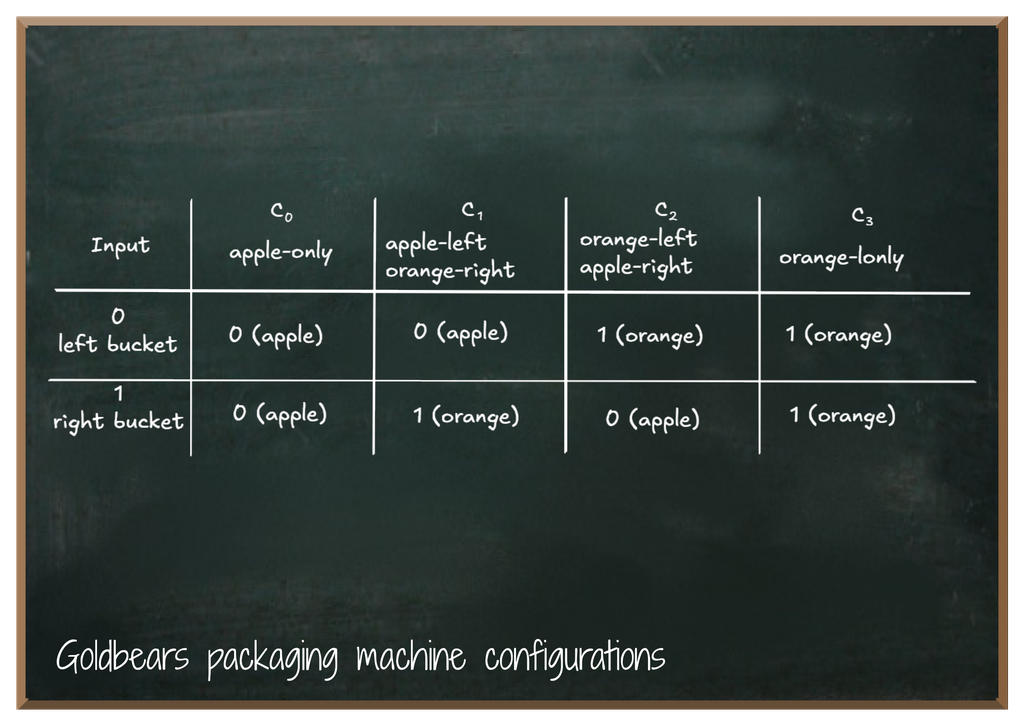
Configuration 0 (): apple-only
In this incorrect configuration, the machine only ever dispenses apple-flavored bears, as both buckets only contain apple.
Left bucket (input value ) → apple (output value )
Right bucket (input value ) → apple (output value )
Configuration 1 (): apple-left, orange-right
In this correct configuration, the machine outputs a mixture of both flavors.
Left bucket (input value ) → apple (output value )
Right bucket (input value ) → orange (output value )
Configuration 2 (): orange-left, apple-right
In this correct configuration, the machine outputs a mixture of both flavors.
Left bucket (input value ) → orange (output value )
Right bucket (input value ) → apple (output value )
Configuration 3 (): orange-only
In this incorrect configuration, the machine only ever dispenses orange-flavored bears, as both buckets only contain orange.
Left bucket (input value ) → orange (output value )
Right bucket (input value ) → orange (output value )
Here is a table summarizing the behavior of these configurations:
The packaging machine now fills the bags by opening both filling openings. In configurations (apple-left, orange-right) and (orange-left, apple-right), the bags therefore contain a mixture of both flavors. These configurations are therefore correct.
However, configurations (apple-only) and (orange-only) result in the bags containing only a single flavor. These configurations are therefore incorrect.
As Goldbears Quality Check Managers (I think I've finally found my calling), we now have to check whether the packaging machines have been configured correctly or incorrectly.
Unfortunately, we can't see inside the buckets or the entire package at once. The only way to identify the flavor of a bear is to eat it. That's a shame, of course.
The question now is how many bears you have to eat to determine whether there are only bears with one flavor or bears with both flavors.
The problem we are actually solving
Note what we are not asking.
We are not asking what configuration the machine is in.
We do not ask which flavor is on the left or right.
We only ask the following: Are the two results the same or different?
Furthermore, we may only access information about the problem at hand by performing an An oracle is a black-box function that encodes information about a problem—typically deciding whether a given input satisfies some condition. It’s implemented as a quantum operation that can be queried in superposition, allowing a quantum algorithm to extract global properties of the function more efficiently than classical methods. Oracles are central to algorithms like Grover’s and Deutsch–Jozsa, where they guide the computation without revealing internal details. Learn more about Oracle query that uses the position of the bucket as a parameter and outputs the flavor of the bear in that bucket.
That is the entire problem.
Why this framing decides everything
So far, nothing has been said about algorithms. No classic tricks. No A quantum circuit is a sequence of quantum gates applied to qubits, representing the operations in a quantum computation. Each gate changes the qubits’ state using quantum mechanics principles like superposition and entanglement. The final qubit states, when measured, yield the circuit’s computational result probabilistically. Learn more about Quantum Circuit No acceleration. And that's exactly what it's all about.
Before we can talk about any Quantum advantage is the point where a quantum computer performs a specific task faster or more efficiently than the best possible classical computer. It doesn’t mean quantum computers are universally better—just that they outperform classical ones for that task. The first demonstrations (e.g., Google’s 2019 Sycamore experiment) showed speedups for highly specialized problems, not yet for practical applications. Learn more about Quantum Advantage we first have to freeze the problem into something solid. We have to say exactly what can be asked, what will be returned, and how much information each interaction will provide. This definition is the An oracle is a black-box function that encodes information about a problem—typically deciding whether a given input satisfies some condition. It’s implemented as a quantum operation that can be queried in superposition, allowing a quantum algorithm to extract global properties of the function more efficiently than classical methods. Oracles are central to algorithms like Grover’s and Deutsch–Jozsa, where they guide the computation without revealing internal details. Learn more about Oracle
Once the An oracle is a black-box function that encodes information about a problem—typically deciding whether a given input satisfies some condition. It’s implemented as a quantum operation that can be queried in superposition, allowing a quantum algorithm to extract global properties of the function more efficiently than classical methods. Oracles are central to algorithms like Grover’s and Deutsch–Jozsa, where they guide the computation without revealing internal details. Learn more about Oracle is defined, the rules are also defined. Information flows only through the interface you define. And the number of calls to that interface becomes our performance metric.
It may seem meticulous to spend so much time defining the problem. But if you skip this step, any subsequent claim becomes inaccurate. You could unknowingly change the An oracle is a black-box function that encodes information about a problem—typically deciding whether a given input satisfies some condition. It’s implemented as a quantum operation that can be queried in superposition, allowing a quantum algorithm to extract global properties of the function more efficiently than classical methods. Oracles are central to algorithms like Grover’s and Deutsch–Jozsa, where they guide the computation without revealing internal details. Learn more about Oracle introduce additional information, or compare algorithms that solve slightly different problems. At that point, any claimed advantage is meaningless.
We need to understand the problem well enough to specify the An oracle is a black-box function that encodes information about a problem—typically deciding whether a given input satisfies some condition. It’s implemented as a quantum operation that can be queried in superposition, allowing a quantum algorithm to extract global properties of the function more efficiently than classical methods. Oracles are central to algorithms like Grover’s and Deutsch–Jozsa, where they guide the computation without revealing internal details. Learn more about Oracle accurately. Only then does it make sense to ask whether a A quantum algorithm is a step-by-step computational procedure designed to run on a quantum computer, exploiting quantum phenomena such as superposition, entanglement, and interference to solve certain problems more efficiently than classical algorithms. Learn more about Quantum Algorithm is better than a classical algorithm. Measured by the fact that fewer queries to the An oracle is a black-box function that encodes information about a problem—typically deciding whether a given input satisfies some condition. It’s implemented as a quantum operation that can be queried in superposition, allowing a quantum algorithm to extract global properties of the function more efficiently than classical methods. Oracles are central to algorithms like Grover’s and Deutsch–Jozsa, where they guide the computation without revealing internal details. Learn more about Oracle are required.