Fourier Basis
The Fourier basis is a set of sine and cosine functions that can represent any periodic signal as a weighted sum of these functions. Each basis function corresponds to a specific frequency, capturing how much of that frequency is present in the signal. In essence, it’s the coordinate system for expressing signals in terms of their frequency components instead of time.
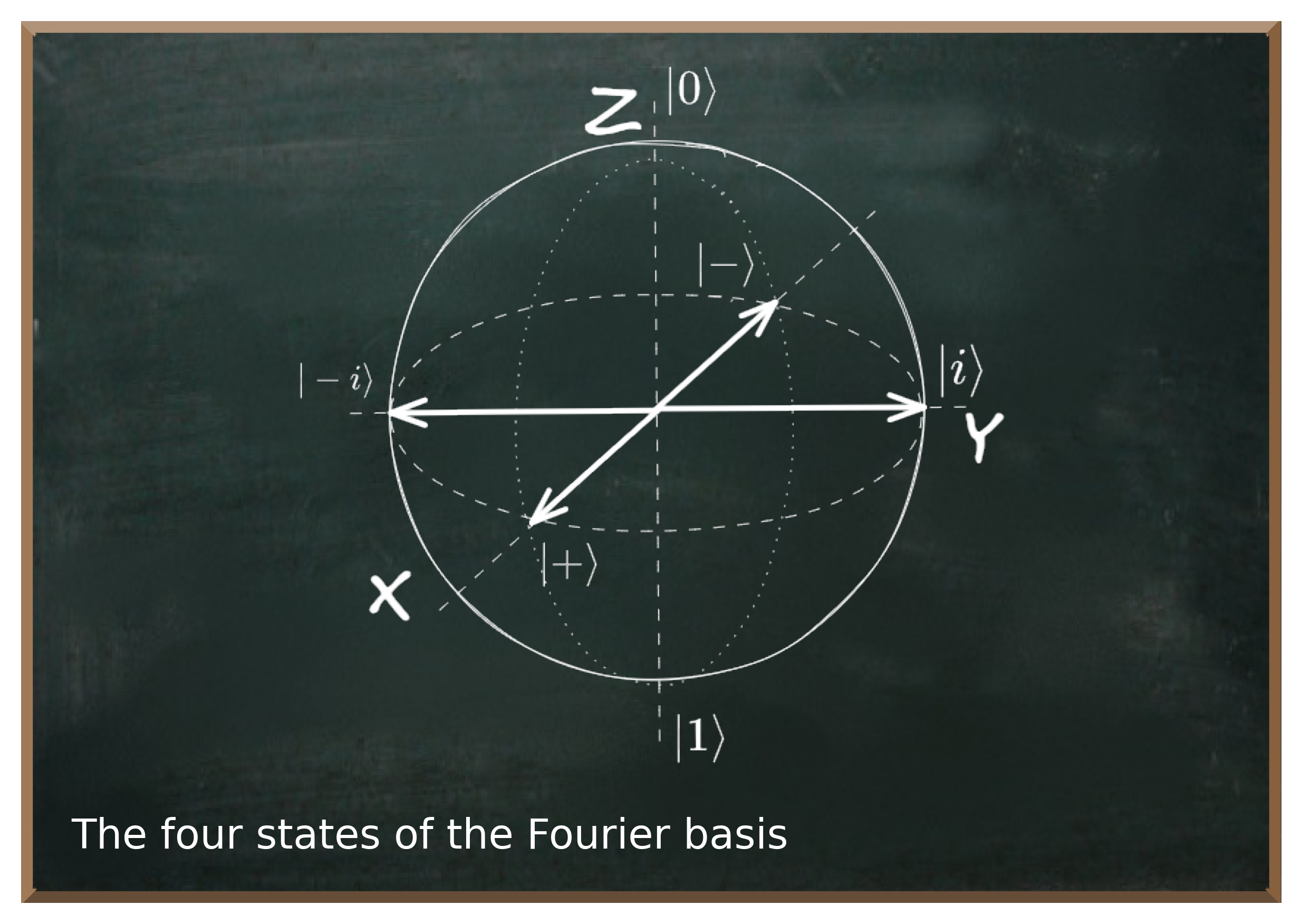
You are told that A qubit is the basic unit of quantum information, representing a superposition of 0 and 1 states.
Learn more about Quantum Bitare very different from classical A bit (short for “binary digit”) is the smallest unit of data in computing, representing a value of either 0 or 1. It’s the fundamental building block of all digital information. Multiple bits combine to form larger units like bytes (8 bits) and encode more complex data such as numbers, text, or images.
Learn more about Binary Digit However, in the standard The computational basis is the standard set of basis states used to describe qubits in quantum computing. These are typically
Learn more about Computational Basis your A qubit is the basic unit of quantum information, representing a superposition of 0 and 1 states.
Learn more about Quantum Bitbehave like classical A bit (short for “binary digit”) is the smallest unit of data in computing, representing a value of either 0 or 1. It’s the fundamental building block of all digital information. Multiple bits combine to form larger units like bytes (8 bits) and encode more complex data such as numbers, text, or images.
Learn more about Binary Digit A state such as
Learn more about Superposition, you are basically just juggling a list of probabilities associated with certain numbers. That sounds very advanced, but is it also advantageous?
Complex problems in Quantum Computing is a different kind of computation that builds upon the phenomena of Quantum Mechanics.
Learn more about Quantum Computing such as cracking encryption or simulating a molecule, cannot be solved by looking at numbers alone. They are solved by finding patterns hidden between the numbers.
When working on a The computational basis is the standard set of basis states used to describe qubits in quantum computing. These are typically
Learn more about Computational Basis these patterns are invisible. You cannot see the frequency of the data, only the data itself. You try to determine the period of a wave by measuring the water level at a billion different points one after the other. This is inefficient and does not lead to the desired acceleration.
At this point, you are faced with a crucial architectural decision. To recognize the pattern, you need to completely change your perspective.
And this is exactly where A qubit is the basic unit of quantum information, representing a superposition of 0 and 1 states.
Learn more about Quantum Bitcome into play. They allow you to swap value for A **quantum phase** is the angle component of a particle’s wavefunction that determines how its probability amplitude interferes with others. It doesn’t affect observable probabilities directly but becomes crucial when comparing two or more states, as phase differences lead to interference effects. Essentially, it encodes the relative timing or “alignment” of quantum waves.
Learn more about Quantum Phase.
You have the option of shifting your A quantum state is the complete mathematical description of a quantum system, containing all the information needed to predict measurement outcomes. It’s usually represented by a wavefunction or a state vector in a Hilbert space. The state defines probabilities, not certainties, for observable quantities like position, momentum, or spin.
Learn more about Quantum State to the The Fourier basis is a set of sine and cosine functions that can represent any periodic signal as a weighted sum of these functions. Each basis function corresponds to a specific frequency, capturing how much of that frequency is present in the signal. In essence, it’s the coordinate system for expressing signals in terms of their frequency components instead of time.
Learn more about Fourier Basis.
It is a special tool with strict operating conditions. You choose the The Fourier basis is a set of sine and cosine functions that can represent any periodic signal as a weighted sum of these functions. Each basis function corresponds to a specific frequency, capturing how much of that frequency is present in the signal. In essence, it’s the coordinate system for expressing signals in terms of their frequency components instead of time.
Learn more about Fourier Basis if your algorithm is based on Periodicity refers to the repeating pattern in the values of a function evaluated over a quantum superposition of inputs. Algorithms like Shor’s exploit this by using the Quantum Fourier Transform (QFT) to detect the period efficiently, something classical methods can’t do quickly. Identifying this period is key to solving problems such as integer factorization and discrete logarithms.
Learn more about Periodicity A **quantum phase** is the angle component of a particle’s wavefunction that determines how its probability amplitude interferes with others. It doesn’t affect observable probabilities directly but becomes crucial when comparing two or more states, as phase differences lead to interference effects. Essentially, it encodes the relative timing or “alignment” of quantum waves.
Learn more about Quantum Phase shifting, or the direct Execution in quantum computing is the process of running a quantum circuit on qubits to perform a computation. It involves applying a sequence of quantum gates (unitary operations) followed by measurement, which collapses the qubits’ superpositions into classical outcomes. Because quantum states are probabilistic, repeated executions (shots) are used to estimate the result distribution accurately.
Learn more about Execution of arithmetic in the A **quantum phase** is the angle component of a particle’s wavefunction that determines how its probability amplitude interferes with others. It doesn’t affect observable probabilities directly but becomes crucial when comparing two or more states, as phase differences lead to interference effects. Essentially, it encodes the relative timing or “alignment” of quantum waves.
Learn more about Quantum Phase domain. If you are building an adder or multiplier, this basis allows you to perform these operations with simple rotations.
But this choice carries risk. If your problem requires simple Boolean logic the The Fourier basis is a set of sine and cosine functions that can represent any periodic signal as a weighted sum of these functions. Each basis function corresponds to a specific frequency, capturing how much of that frequency is present in the signal. In essence, it’s the coordinate system for expressing signals in terms of their frequency components instead of time.
Learn more about Fourier Basis will fight you. If you aim to check if a A bit (short for “binary digit”) is the smallest unit of data in computing, representing a value of either 0 or 1. It’s the fundamental building block of all digital information. Multiple bits combine to form larger units like bytes (8 bits) and encode more complex data such as numbers, text, or images.
Learn more about Binary Digit is 0 or 1 to trigger a condition, you will have to uncompute everything to get back to a state where "0" and "1" make sense. Furthermore, the transformation costs you gates. It adds overhead. If the problem doesn't inherently involve frequency or A **quantum phase** is the angle component of a particle’s wavefunction that determines how its probability amplitude interferes with others. It doesn’t affect observable probabilities directly but becomes crucial when comparing two or more states, as phase differences lead to interference effects. Essentially, it encodes the relative timing or “alignment” of quantum waves.
Learn more about Quantum Phase structure, that overhead is wasted.
You must also manage the risk of overflow. In this basis, values are encoded as angles. Angles are cyclic;
If you decide to use it, The Quantum Fourier Transform (QFT) is the quantum analog of the discrete Fourier transform, mapping quantum states from the computational basis to the frequency domain using quantum superposition and interference. It transforms amplitudes so that periodic patterns in the input become phase differences in the output. The QFT is exponentially faster than the classical Fourier transform, making it central to algorithms like Shor’s factoring algorithm.
Learn more about Quantum Fourier Transform (The Quantum Fourier Transform (QFT) is the quantum analog of the discrete Fourier transform, mapping quantum states from the computational basis to the frequency domain using quantum superposition and interference. It transforms amplitudes so that periodic patterns in the input become phase differences in the output. The QFT is exponentially faster than the classical Fourier transform, making it central to algorithms like Shor’s factoring algorithm.
Learn more about Quantum Fourier Transform will become your tool of choice. Here's what happens to your data and why it solves your problem.
First, the transform takes your standard number, for example
Learn more about Fourier Basis this single number becomes an even Superposition in quantum computing means a quantum bit (qubit) can exist in multiple states (0 and 1) at the same time, rather than being limited to one like a classical bit. Mathematically, it’s a linear combination of basis states with complex probability amplitudes. This allows quantum computers to process many possible inputs simultaneously, enabling exponential speedups for certain problems.
Learn more about Superpositionof all possible numbers. This sounds counterintuitive. Why would you want to encrypt your data?
You do this because you no longer store information in probabilities. You store it in the A **quantum phase** is the angle component of a particle’s wavefunction that determines how its probability amplitude interferes with others. It doesn’t affect observable probabilities directly but becomes crucial when comparing two or more states, as phase differences lead to interference effects. Essentially, it encodes the relative timing or “alignment” of quantum waves.
Learn more about Quantum Phase
The The Quantum Fourier Transform (QFT) is the quantum analog of the discrete Fourier transform, mapping quantum states from the computational basis to the frequency domain using quantum superposition and interference. It transforms amplitudes so that periodic patterns in the input become phase differences in the output. The QFT is exponentially faster than the classical Fourier transform, making it central to algorithms like Shor’s factoring algorithm.
Learn more about Quantum Fourier Transform rotates each A qubit is the basic unit of quantum information, representing a superposition of 0 and 1 states.
Learn more about Quantum Bitaround the Z axis of the The Bloch sphere is a geometric representation of a single qubit’s quantum state as a point on or inside a unit sphere. The north and south poles represent the classical states |0⟩ and |1⟩, while any other point corresponds to a superposition of them. Its position encodes the qubit’s relative phase and probability amplitudes, making it a visual tool for understanding quantum state evolution.
Learn more about Bloch Sphere. The “speed” of this rotation encodes the value.
- The problem solved: In the The computational basis is the standard set of basis states used to describe qubits in quantum computing. These are typically
and for a single qubit. For multi-qubit systems all possible combinations of basis states denote the computational basis, like , , , and . These states correspond to classical bit strings and form an orthonormal basis for the system's Hilbert space. Any quantum state can be expressed as a superposition of these computational basis states.
Learn more about Computational Basis adding numbers requires complex carry logic (as in paper-based arithmetic). - The solution: In the The Fourier basis is a set of sine and cosine functions that can represent any periodic signal as a weighted sum of these functions. Each basis function corresponds to a specific frequency, capturing how much of that frequency is present in the signal. In essence, it’s the coordinate system for expressing signals in terms of their frequency components instead of time.
Learn more about Fourier Basis adding a numbersimply means rotating the A qubit is the basic unit of quantum information, representing a superposition of 0 and 1 states.
Learn more about Quantum Bitby a certain angle. No carries, just rotation.
The key point is that this configuration prepares you for Interference in quantum computing refers to the way probability amplitudes of quantum states combine—sometimes reinforcing each other (constructive interference) or canceling out (destructive interference). Quantum algorithms exploit this to amplify the probability of correct answers while suppressing incorrect ones. It’s a key mechanism that gives quantum computers their computational advantage.
Learn more about Interference. When you finally transform back (using the In math, an *inverse* undoes the effect of an operation or function. For a number, the inverse under addition is its opposite (e.g., the inverse of 5 is −5), and under multiplication it’s its reciprocal (e.g., the inverse of 5 is 1/5). For a function ( f(x) ), the inverse ( f^(x) ) reverses its action so that ( f(f^(x)) = x ).
Learn more about Inverse The Quantum Fourier Transform (QFT) is the quantum analog of the discrete Fourier transform, mapping quantum states from the computational basis to the frequency domain using quantum superposition and interference. It transforms amplitudes so that periodic patterns in the input become phase differences in the output. The QFT is exponentially faster than the classical Fourier transform, making it central to algorithms like Shor’s factoring algorithm.
Learn more about Quantum Fourier Transform the wrong answers, i.e., the states with colliding A **quantum phase** is the angle component of a particle’s wavefunction that determines how its probability amplitude interferes with others. It doesn’t affect observable probabilities directly but becomes crucial when comparing two or more states, as phase differences lead to interference effects. Essentially, it encodes the relative timing or “alignment” of quantum waves.
Learn more about Quantum Phase cancel each other out (destructive Interference in quantum computing refers to the way probability amplitudes of quantum states combine—sometimes reinforcing each other (constructive interference) or canceling out (destructive interference). Quantum algorithms exploit this to amplify the probability of correct answers while suppressing incorrect ones. It’s a key mechanism that gives quantum computers their computational advantage.
Learn more about Interference). The correct answers, i.e., the states with periodic A **quantum phase** is the angle component of a particle’s wavefunction that determines how its probability amplitude interferes with others. It doesn’t affect observable probabilities directly but becomes crucial when comparing two or more states, as phase differences lead to interference effects. Essentially, it encodes the relative timing or “alignment” of quantum waves.
Learn more about Quantum Phase that align, reinforce each other (constructive Interference in quantum computing refers to the way probability amplitudes of quantum states combine—sometimes reinforcing each other (constructive interference) or canceling out (destructive interference). Quantum algorithms exploit this to amplify the probability of correct answers while suppressing incorrect ones. It’s a key mechanism that gives quantum computers their computational advantage.
Learn more about Interference).
You use the The Fourier basis is a set of sine and cosine functions that can represent any periodic signal as a weighted sum of these functions. Each basis function corresponds to a specific frequency, capturing how much of that frequency is present in the signal. In essence, it’s the coordinate system for expressing signals in terms of their frequency components instead of time.
Learn more about Fourier Basis to set this trap. You do not calculate the answer, but arrange the A **quantum phase** is the angle component of a particle’s wavefunction that determines how its probability amplitude interferes with others. It doesn’t affect observable probabilities directly but becomes crucial when comparing two or more states, as phase differences lead to interference effects. Essentially, it encodes the relative timing or “alignment” of quantum waves.
Learn more about Quantum Phase so that the wrong answers destroy each other.
So, when do you actually use this?
1. You need to break an RSA key (Shor’s Algorithm is a quantum algorithm for factoring large integers efficiently—something classical computers can only do very slowly. It works by using quantum parallelism and the Quantum Fourier Transform to find the period of a modular exponentiation function, which reveals the factors. Its efficiency threatens current cryptographic systems like RSA that rely on the hardness of factoring.
Learn more about Shor's Algorithm
You choose the The Fourier basis is a set of sine and cosine functions that can represent any periodic signal as a weighted sum of these functions. Each basis function corresponds to a specific frequency, capturing how much of that frequency is present in the signal. In essence, it’s the coordinate system for expressing signals in terms of their frequency components instead of time.
Learn more about Fourier Basis here because factoring a large integer is actually a problem of finding the period of a function. The function repeats itself. The The Fourier basis is a set of sine and cosine functions that can represent any periodic signal as a weighted sum of these functions. Each basis function corresponds to a specific frequency, capturing how much of that frequency is present in the signal. In essence, it’s the coordinate system for expressing signals in terms of their frequency components instead of time.
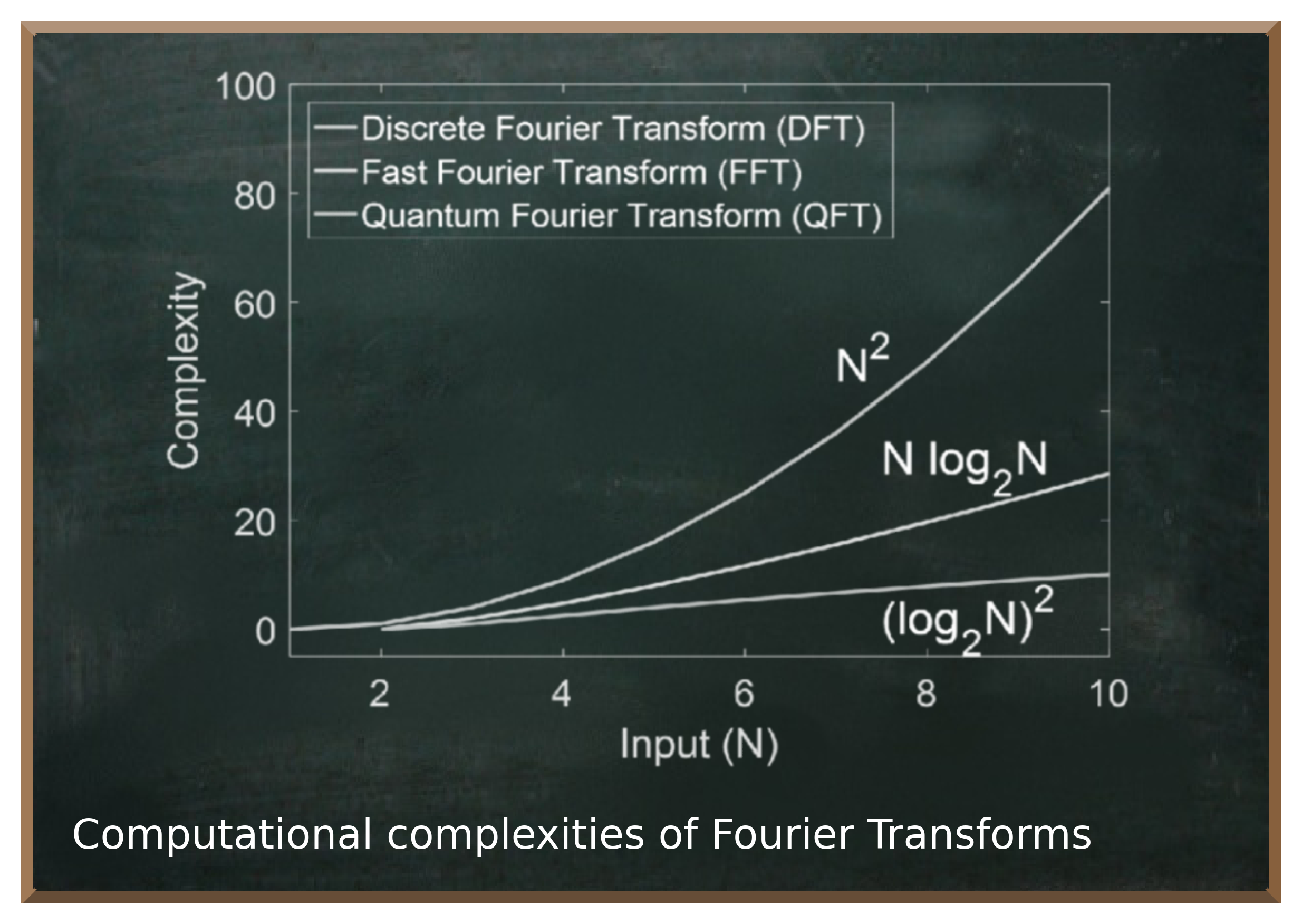
Learn more about Fourier Basis is the only tool that can take that repetition and concentrate the probability into a single, measurable peak. The tradeoff is the Circuit depth in quantum computing is the number of layers of quantum gates that must be applied sequentially, where gates acting on different qubits in parallel count as one layer. It measures how long a quantum computation takes, assuming gates in the same layer happen simultaneously. Lower depth is crucial because qubits lose coherence over time, so deep circuits are more error-prone.
Learn more about Circuit Depth And this becomes a problem to run on noisy hardware. Even though the complexity beats classical algorithms.
2. You need to simulate a chemical bond (Quantum Phase Estimation (QPE) is a quantum algorithm that determines the phase
Learn more about Quantum Phase Estimation
In chemistry simulations, the energy of a molecule is related to the An eigenvalue is a number that indicates how much a linear transformation stretches or compresses a vector that doesn’t change direction under that transformation (called an eigenvector). Mathematically, it satisfies ( A v = \lambda v ), where ( A ) is a square matrix, ( v ) is the eigenvector, and ( \lambda ) is the eigenvalue. In essence, it measures the scaling factor applied to certain special directions of a transformation.
Learn more about Eigenvalue of its operator. This An eigenvalue is a number that indicates how much a linear transformation stretches or compresses a vector that doesn’t change direction under that transformation (called an eigenvector). Mathematically, it satisfies ( A v = \lambda v ), where ( A ) is a square matrix, ( v ) is the eigenvector, and ( \lambda ) is the eigenvalue. In essence, it measures the scaling factor applied to certain special directions of a transformation.
Learn more about Eigenvalue is encoded as a A **quantum phase** is the angle component of a particle’s wavefunction that determines how its probability amplitude interferes with others. It doesn’t affect observable probabilities directly but becomes crucial when comparing two or more states, as phase differences lead to interference effects. Essentially, it encodes the relative timing or “alignment” of quantum waves.
Learn more about Quantum Phase You cannot measure A **quantum phase** is the angle component of a particle’s wavefunction that determines how its probability amplitude interferes with others. It doesn’t affect observable probabilities directly but becomes crucial when comparing two or more states, as phase differences lead to interference effects. Essentially, it encodes the relative timing or “alignment” of quantum waves.
Learn more about Quantum Phase directly. You use the The Fourier basis is a set of sine and cosine functions that can represent any periodic signal as a weighted sum of these functions. Each basis function corresponds to a specific frequency, capturing how much of that frequency is present in the signal. In essence, it’s the coordinate system for expressing signals in terms of their frequency components instead of time.
Learn more about Fourier Basis (specifically the In math, an *inverse* undoes the effect of an operation or function. For a number, the inverse under addition is its opposite (e.g., the inverse of 5 is −5), and under multiplication it’s its reciprocal (e.g., the inverse of 5 is 1/5). For a function ( f(x) ), the inverse ( f^(x) ) reverses its action so that ( f(f^(x)) = x ).
Learn more about Inverse The Quantum Fourier Transform (QFT) is the quantum analog of the discrete Fourier transform, mapping quantum states from the computational basis to the frequency domain using quantum superposition and interference. It transforms amplitudes so that periodic patterns in the input become phase differences in the output. The QFT is exponentially faster than the classical Fourier transform, making it central to algorithms like Shor’s factoring algorithm.
Learn more about Quantum Fourier Transform to translate that unreadable A **quantum phase** is the angle component of a particle’s wavefunction that determines how its probability amplitude interferes with others. It doesn’t affect observable probabilities directly but becomes crucial when comparing two or more states, as phase differences lead to interference effects. Essentially, it encodes the relative timing or “alignment” of quantum waves.
Learn more about Quantum Phase information into readable binary numbers.
Look at this Qiskit is an open-source Python framework for programming and simulating quantum computers. It lets users create quantum circuits, run them on real quantum hardware or simulators, and analyze the results. Essentially, it bridges high-level quantum algorithms with low-level hardware execution.
Learn more about Qiskit script. This lets you inspect the transformation to verify your control over the state.
Here is the revised section following the code example. It corrects the interpretation to align exactly with your experimental results.
The Trap of Equal Probability
Look closely at the output you generated:
Statevector([ 3.53553391e-01... , -2.50000000e-01-2.50000000e-01j... ])
You will notice the numbers themselves are different. Some are real, some are complex mixtures. This difference is critical. It is where your data (the number 5) is now hidden. These are the In quantum computing an amplitude is a complex number that describes the weight of a basis state in a quantum superposition. The squared magnitude of an amplitude gives the probability of measuring that basis state. Amplitudes can interfere, this means adding or canceling, allowing quantum algorithms to bias outcomes toward correct solutions.
Learn more about Amplitude

But if you calculate the magnitude (absolute value) of any of those numbers, you will find they are identical:
This confirms the core mechanism of the The Fourier basis is a set of sine and cosine functions that can represent any periodic signal as a weighted sum of these functions. Each basis function corresponds to a specific frequency, capturing how much of that frequency is present in the signal. In essence, it’s the coordinate system for expressing signals in terms of their frequency components instead of time.
Learn more about Fourier Basis it spreads the probability of finding the A qubit is the basic unit of quantum information, representing a superposition of 0 and 1 states.
Learn more about Quantum Bitequally across all possible states (a flat magnitude), while encoding the unique value of your original number entirely into the rotating A **quantum phase** is the angle component of a particle’s wavefunction that determines how its probability amplitude interferes with others. It doesn’t affect observable probabilities directly but becomes crucial when comparing two or more states, as phase differences lead to interference effects. Essentially, it encodes the relative timing or “alignment” of quantum waves.
Learn more about Quantum Phase (the changing ratio of real to imaginary parts).
If you were to measure this state right now, you would have an equal 12.5% chance of seeing any of the 8 possible bitstrings. The information is hidden in the relationship between the real and imaginary parts, not in the likelihood of In quantum computing, measurement is the process of extracting classical information from a quantum state. It collapses a qubit’s superposition into one of its basis states (usually
Learn more about Measurement
You might think that because the The Fourier basis is a set of sine and cosine functions that can represent any periodic signal as a weighted sum of these functions. Each basis function corresponds to a specific frequency, capturing how much of that frequency is present in the signal. In essence, it’s the coordinate system for expressing signals in terms of their frequency components instead of time.
Learn more about Fourier Basis touches every possible state, you can simply "check" all possible answers at once. This is false.
The The Fourier basis is a set of sine and cosine functions that can represent any periodic signal as a weighted sum of these functions. Each basis function corresponds to a specific frequency, capturing how much of that frequency is present in the signal. In essence, it’s the coordinate system for expressing signals in terms of their frequency components instead of time.
Learn more about Fourier Basis allows you to process all frequencies, but you can only measure one result. The biggest mistake you can make is assuming the The Quantum Fourier Transform (QFT) is the quantum analog of the discrete Fourier transform, mapping quantum states from the computational basis to the frequency domain using quantum superposition and interference. It transforms amplitudes so that periodic patterns in the input become phase differences in the output. The QFT is exponentially faster than the classical Fourier transform, making it central to algorithms like Shor’s factoring algorithm.
Learn more about Quantum Fourier Transform gives you parallel computing for free. It does not. It gives you Interference in quantum computing refers to the way probability amplitudes of quantum states combine—sometimes reinforcing each other (constructive interference) or canceling out (destructive interference). Quantum algorithms exploit this to amplify the probability of correct answers while suppressing incorrect ones. It’s a key mechanism that gives quantum computers their computational advantage.
Learn more about Interference.
If you measure now, you get random Noise
Learn more about Noise You must design your algorithm to make the correct A **quantum phase** is the angle component of a particle’s wavefunction that determines how its probability amplitude interferes with others. It doesn’t affect observable probabilities directly but becomes crucial when comparing two or more states, as phase differences lead to interference effects. Essentially, it encodes the relative timing or “alignment” of quantum waves.
Learn more about Quantum Phase align (constructive Interference in quantum computing refers to the way probability amplitudes of quantum states combine—sometimes reinforcing each other (constructive interference) or canceling out (destructive interference). Quantum algorithms exploit this to amplify the probability of correct answers while suppressing incorrect ones. It’s a key mechanism that gives quantum computers their computational advantage.
Learn more about Interference) and the incorrect ones cancel (destructive Interference in quantum computing refers to the way probability amplitudes of quantum states combine—sometimes reinforcing each other (constructive interference) or canceling out (destructive interference). Quantum algorithms exploit this to amplify the probability of correct answers while suppressing incorrect ones. It’s a key mechanism that gives quantum computers their computational advantage.
Learn more about Interference) before you measure. If you don't, the The Fourier basis is a set of sine and cosine functions that can represent any periodic signal as a weighted sum of these functions. Each basis function corresponds to a specific frequency, capturing how much of that frequency is present in the signal. In essence, it’s the coordinate system for expressing signals in terms of their frequency components instead of time.
Learn more about Fourier Basis gives you nothing but random static.