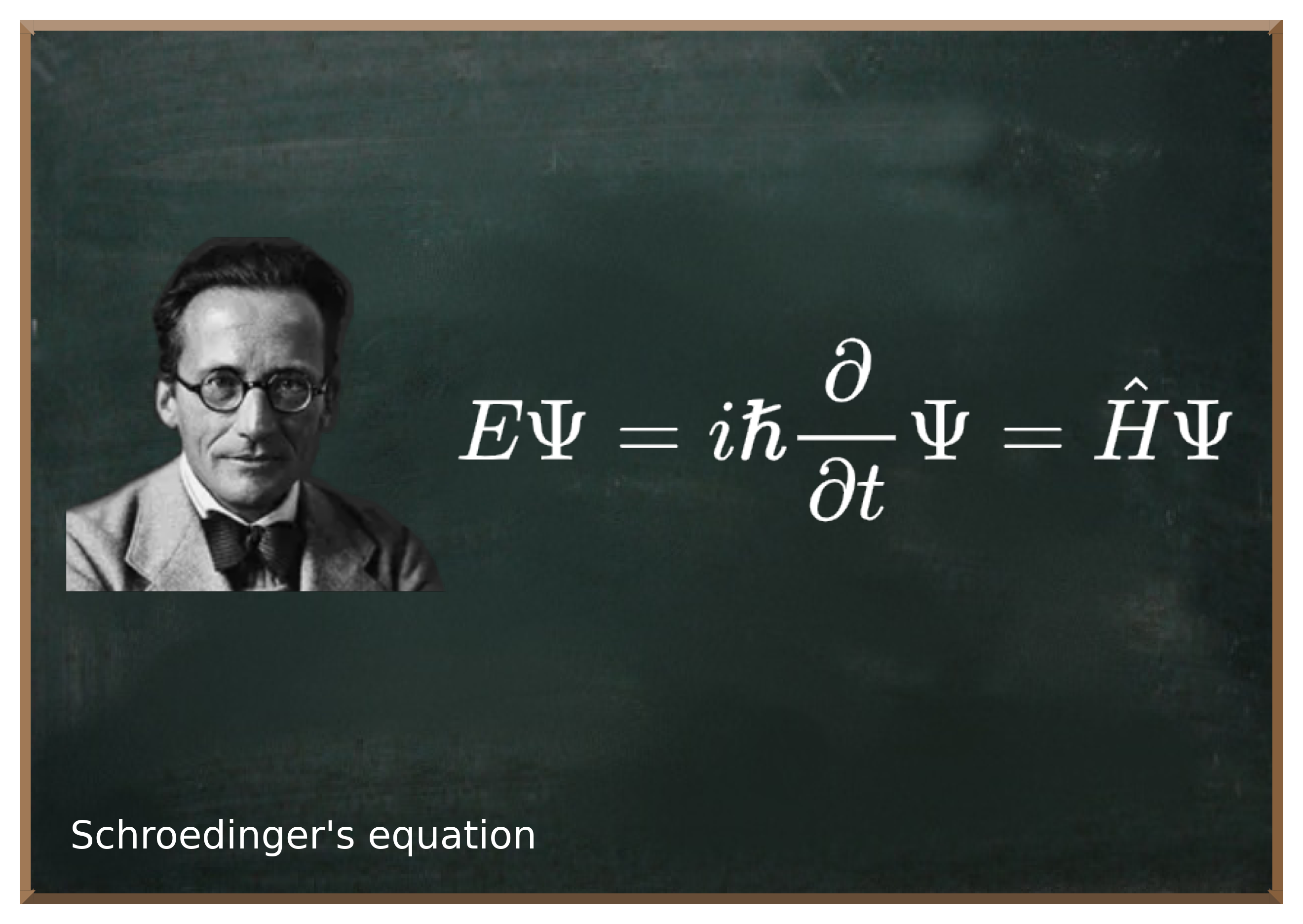
Schrödinger’s equation describes how the quantum state (wavefunction) of a physical system changes over time. It’s the fundamental equation of quantum mechanics, playing a role similar to Newton’s laws in classical physics. The equation links the wavefunction’s curvature (its spatial behavior) to the system’s energy, determining the probabilities of measurable outcomes.
by Frank ZickertFebruary 19, 2026
The Rule You Can’t Ignore
You’re designing a quantum operation. You build a circuit with a few A qubit is the basic unit of quantum information, representing a superposition of 0 and 1 states. Learn more about Quantum Bit You apply gates. You expect a specific Interference in quantum computing refers to the way probability amplitudes of quantum states combine—sometimes reinforcing each other (constructive interference) or canceling out (destructive interference). Quantum algorithms exploit this to amplify the probability of correct answers while suppressing incorrect ones. It’s a key mechanism that gives quantum computers their computational advantage. Learn more about Interference pattern at the end. But between “apply gate” and “measure,” something physical happens. The A qubit is the basic unit of quantum information, representing a superposition of 0 and 1 states. Learn more about Quantum Bit evolve.
If you want to design algorithms instead of just assembling circuits, you need to know what governs that evolution. If you ignore it, you don’t control what your hardware is actually doing.
That governing rule is Schrödinger’s equation.
When you work on A quantum algorithm is a step-by-step computational procedure designed to run on a quantum computer, exploiting quantum phenomena such as superposition, entanglement, and interference to solve certain problems more efficiently than classical algorithms. Learn more about Quantum Algorithm you have choices about how deeply you model the system.
You can:
Work at the circuit level and assume gates are perfect.
Model Noise Learn more about Noise and In quantum computing, measurement is the process of extracting classical information from a quantum state. It collapses a qubit’s superposition into one of its basis states (usually or ), with probabilities determined by the amplitudes of those states. After measurement, the qubit’s state becomes definite, destroying the original superposition. Learn more about Measurement using density matrices.
Or model ideal, closed-system evolution using Schrödinger’s equation.
Schrödinger’s equation helps when:
You care about how A qubit is the basic unit of quantum information, representing a superposition of 0 and 1 states. Learn more about Quantum Bit evolve under a specific Hamiltonian.
You want to understand where a gate actually comes from.
You’re dealing with Hamiltonian simulation is the process of using a quantum computer to mimic the time evolution of a quantum system governed by a Hamiltonian , typically by approximating . It allows prediction of how a quantum state changes over time without physically realizing the system. This is fundamental to quantum algorithms for chemistry, materials science, and physics because it efficiently reproduces complex quantum dynamics that are intractable for classical computers. Learn more about Hamiltonian Simulation analog computing, or parameterized evolutions.
It works against you when:
Noise Learn more about Noise and Decoherence is the process by which a quantum system loses its quantum behavior—like superposition—because it interacts with its surrounding environment. These interactions cause the system’s quantum states to become entangled with the environment, effectively destroying the system’s coherent phase relationships. As a result, the system starts to behave classically rather than quantum mechanically. Learn more about Decoherence dominate (it assumes a closed system).
You need to model In quantum computing, measurement is the process of extracting classical information from a quantum state. It collapses a qubit’s superposition into one of its basis states (usually or ), with probabilities determined by the amplitudes of those states. After measurement, the qubit’s state becomes definite, destroying the original superposition. Learn more about Measurement collapse (it doesn’t describe that).
The system grows large (state size doubles with every A qubit is the basic unit of quantum information, representing a superposition of 0 and 1 states. Learn more about Quantum Bit
The risk: you may mistake ideal evolution for real hardware behavior. Or you may think it explains speedup. It doesn’t. It only governs motion.
You use it when you want control over evolution. You avoid it when your problem is about Noise Learn more about Noise or In quantum computing, measurement is the process of extracting classical information from a quantum state. It collapses a qubit’s superposition into one of its basis states (usually or ), with probabilities determined by the amplitudes of those states. After measurement, the qubit’s state becomes definite, destroying the original superposition. Learn more about Measurement
At some point, you need to know what moves your A qubit is the basic unit of quantum information, representing a superposition of 0 and 1 states. Learn more about Quantum Bit The rule is:
You don’t need to love the math. You need to know what each part does for you.
The state is what you’re trying to control. This is the A vector is a mathematical object that has both magnitude (size) and direction. It’s often represented as an arrow or as an ordered list of numbers (components) that describe its position in space, such as . Vectors are used to represent quantities like velocity, force, or displacement. Learn more about Vector of In quantum computing an amplitude is a complex number that describes the weight of a basis state in a quantum superposition. The squared magnitude of an amplitude gives the probability of measuring that basis state. Amplitudes can interfere, this means adding or canceling, allowing quantum algorithms to bias outcomes toward correct solutions. Learn more about Amplitude over all A basis state in quantum computing is one of the fundamental states that form the building blocks of a quantum system’s state space. For a single qubit, the basis states are and ; any other qubit state is a superposition of these. In systems with multiple qubits, basis states are all possible combinations of s and s (e.g., , , , and ), forming an orthonormal basis for the system’s Hilbert space. Learn more about Basis State
For A qubit is the basic unit of quantum information, representing a superposition of 0 and 1 states. Learn more about Quantum Bit that’s A complex number is a number that has two parts: a real part and an imaginary part, written as , where . The real part behaves like ordinary numbers, while the imaginary part represents a direction perpendicular to the real axis on the complex plane. Complex numbers let us represent and calculate quantities involving square roots of negative numbers. Learn more about Complex Number
Your problem: you must shape these In quantum computing an amplitude is a complex number that describes the weight of a basis state in a quantum superposition. The squared magnitude of an amplitude gives the probability of measuring that basis state. Amplitudes can interfere, this means adding or canceling, allowing quantum algorithms to bias outcomes toward correct solutions. Learn more about Amplitude so Interference in quantum computing refers to the way probability amplitudes of quantum states combine—sometimes reinforcing each other (constructive interference) or canceling out (destructive interference). Quantum algorithms exploit this to amplify the probability of correct answers while suppressing incorrect ones. It’s a key mechanism that gives quantum computers their computational advantage. Learn more about Interference works in your favor.
Schrödinger’s equation tells you how those In quantum computing an amplitude is a complex number that describes the weight of a basis state in a quantum superposition. The squared magnitude of an amplitude gives the probability of measuring that basis state. Amplitudes can interfere, this means adding or canceling, allowing quantum algorithms to bias outcomes toward correct solutions. Learn more about Amplitude change over time. This is where the The Hamiltonian operator () in quantum mechanics represents the total energy of a system — both kinetic and potential. It acts on a wavefunction to determine how the system evolves over time, according to the Schrödinger equation. Mathematically, , where is the kinetic energy operator and is the potential energy operator. Learn more about Hamiltonian Operator comes into play. The Hamiltonian represents total energy and interactions.
For you, it answers: What transformation is being applied?
If you choose a different Hamiltonian, you get different evolution.
This is where physical hardware and algorithm design meet. The Hamiltonian determines what A **unitary operator** is a linear operator ( U ) on a complex vector space that satisfies ( U^\dagger U = UU^\dagger = I ), meaning it preserves inner products. In simpler terms, it preserves the **length** and **angle** between vectors—so it represents a **reversible, norm-preserving transformation**. In quantum mechanics, unitary operators describe the evolution of isolated systems because they conserve probability. Learn more about Unitary Operator operation you get.
Solving the equation gives:
That exponential is the key.
It produces a A **unitary operator** is a linear operator ( U ) on a complex vector space that satisfies ( U^\dagger U = UU^\dagger = I ), meaning it preserves inner products. In simpler terms, it preserves the **length** and **angle** between vectors—so it represents a **reversible, norm-preserving transformation**. In quantum mechanics, unitary operators describe the evolution of isolated systems because they conserve probability. Learn more about Unitary Operator:
A **unitary operator** is a linear operator ( U ) on a complex vector space that satisfies ( U^\dagger U = UU^\dagger = I ), meaning it preserves inner products. In simpler terms, it preserves the **length** and **angle** between vectors—so it represents a **reversible, norm-preserving transformation**. In quantum mechanics, unitary operators describe the evolution of isolated systems because they conserve probability. Learn more about Unitary Operator means:
Probability is preserved.
The operation is reversible.
That is exactly what A quantum gate is a basic operation that changes the state of one or more qubits, similar to how a logic gate operates on bits in classical computing. It uses unitary transformations, meaning it preserves the total probability (the state’s length in complex space). Quantum gates enable superposition and entanglement, allowing quantum computers to perform computations that classical ones cannot efficiently replicate. Learn more about Quantum Gate must satisfy. So when you apply a gate in a circuit, you are applying the exponential of some Hamiltonian for some time.
If you misunderstand this, you lose control over what your circuit actually represents.
You don’t use Schrödinger’s equation everywhere. You choose it strategically.
For example, if you want to understand where a gate comes from physically, this is your tool. It fits because Gates must be A **unitary operator** is a linear operator ( U ) on a complex vector space that satisfies ( U^\dagger U = UU^\dagger = I ), meaning it preserves inner products. In simpler terms, it preserves the **length** and **angle** between vectors—so it represents a **reversible, norm-preserving transformation**. In quantum mechanics, unitary operators describe the evolution of isolated systems because they conserve probability. Learn more about Unitary Operator And Schrödinger evolution produces unitaries.
But there's a trade-off. You ignore Noise Learn more about Noise You assume ideal control.
Another example. If your algorithm is literally implementing:
then Schrödinger’s equation is not optional. It is the computation. This is because you are simulating physical systems. The math matches exactly that. Unfortunately, the matrix size grows exponentially. So, classical simulation becomes infeasible quickly.
Next, if computation happens by slowly changing a Hamiltonian, the entire process is Schrödinger evolution. The computation is controlled evolution. But real hardware may not stay perfectly isolated.
Finally, and most importantly, Schrödinger's equation is important for variational algorithms (The Variational Quantum Eigensolver (VQE) is a hybrid quantum-classical algorithm used to find the lowest energy (ground state) of a quantum system. It prepares a parameterized quantum state on a quantum computer, measures its energy, and uses a classical optimizer to adjust the parameters to minimize that energy. This approach reduces quantum hardware requirements by offloading the optimization loop to classical computation. Learn more about Variational Quantum Eigensolver QAOA)
You apply parameterized unitaries derived from Hamiltonians. You explicitly control evolution through parameters. But you still assume closed-system dynamics during the A **unitary operator** is a linear operator ( U ) on a complex vector space that satisfies ( U^\dagger U = UU^\dagger = I ), meaning it preserves inner products. In simpler terms, it preserves the **length** and **angle** between vectors—so it represents a **reversible, norm-preserving transformation**. In quantum mechanics, unitary operators describe the evolution of isolated systems because they conserve probability. Learn more about Unitary Operator blocks.
Look at this Qiskit is an open-source Python framework for programming and simulating quantum computers. It lets users create quantum circuits, run them on real quantum hardware or simulators, and analyze the results. Essentially, it bridges high-level quantum algorithms with low-level hardware execution. Learn more about Qiskit example:
1
2
3
4
5
6
7
8
9
10
11
12
13
14
15
16
17
18
19
20
21
22
23
24
25
26
27
28
29
# Qiskit 2.3 example: Time evolution under Z Hamiltonian
from qiskit import QuantumCircuit
from qiskit.quantum_info import Operator
import numpy as np
# Define time parameter
t = 0.5
# Hamiltonian H = Z
Z = np.array([[1, 0],
[0, -1]])
# Time evolution operator U = exp(-iHt)
U = np.linalg.expm(-1j * Z * t)
# Convert to Qiskit operator
U_op = Operator(U)
# Build circuit
qc = QuantumCircuit(1)
qc.unitary(U_op, [0])
qc.draw('text')
You are doing three critical things here:
Defining the Hamiltonian (Z)
This determines the direction of evolution in A Hilbert space is a complete vector space equipped with an inner product, which allows for measuring angles and lengths between vectors. "Complete" means that every Cauchy sequence of vectors converges to a vector within the space. It generalizes the idea of Euclidean space to possibly infinite dimensions and forms the foundation for quantum mechanics and functional analysis. Learn more about Hilbert Space Change it, and you change the gate.
Choosing time t
Time controls how far the state moves. Too small: barely changes the state. Too large: overshoots your intended rotation.
Exponentiating -iHt
This enforces unitarity. If you skip the exponential and insert H directly, you break probability conservation.
What breaks if you misuse it?
Wrong Hamiltonian → wrong gate.
Wrong time → incorrect A **quantum phase** is the angle component of a particle’s wavefunction that determines how its probability amplitude interferes with others. It doesn’t affect observable probabilities directly but becomes crucial when comparing two or more states, as phase differences lead to interference effects. Essentially, it encodes the relative timing or “alignment” of quantum waves. Learn more about Quantum Phase
Non-A **unitary operator** is a linear operator ( U ) on a complex vector space that satisfies ( U^\dagger U = UU^\dagger = I ), meaning it preserves inner products. In simpler terms, it preserves the **length** and **angle** between vectors—so it represents a **reversible, norm-preserving transformation**. In quantum mechanics, unitary operators describe the evolution of isolated systems because they conserve probability. Learn more about Unitary Operator matrix → invalid quantum operation.
This is not abstract theory. It directly determines whether your circuit performs the transformation you think it does.
The misconception you must discard
The biggest misconception is:Schrödinger’s equation explains quantum speedup.
It doesn’t.
It only describes how In quantum computing an amplitude is a complex number that describes the weight of a basis state in a quantum superposition. The squared magnitude of an amplitude gives the probability of measuring that basis state. Amplitudes can interfere, this means adding or canceling, allowing quantum algorithms to bias outcomes toward correct solutions. Learn more about Amplitude evolve in a closed system.
Speedup comes from:
Interference in quantum computing refers to the way probability amplitudes of quantum states combine—sometimes reinforcing each other (constructive interference) or canceling out (destructive interference). Quantum algorithms exploit this to amplify the probability of correct answers while suppressing incorrect ones. It’s a key mechanism that gives quantum computers their computational advantage. Learn more about Interference
Entanglement is a quantum phenomenon where two or more particles become correlated so that measuring one instantly determines the state of the other, no matter how far apart they are. This correlation arises because their quantum states are linked as a single system, not as independent parts. It doesn’t allow faster-than-light communication but shows that quantum systems can share information in ways classical physics can’t explain. Learn more about Entanglement
Exploiting problem structure.
Schrödinger’s equation is the rule of motion. Your algorithm determines whether that motion becomes useful.
So, Schrödinger’s equation is the law that governs ideal A qubit is the basic unit of quantum information, representing a superposition of 0 and 1 states. Learn more about Quantum Bit evolution.
It connects Hamiltonians to A **unitary operator** is a linear operator ( U ) on a complex vector space that satisfies ( U^\dagger U = UU^\dagger = I ), meaning it preserves inner products. In simpler terms, it preserves the **length** and **angle** between vectors—so it represents a **reversible, norm-preserving transformation**. In quantum mechanics, unitary operators describe the evolution of isolated systems because they conserve probability. Learn more about Unitary Operator gates.
It tells you how In quantum computing an amplitude is a complex number that describes the weight of a basis state in a quantum superposition. The squared magnitude of an amplitude gives the probability of measuring that basis state. Amplitudes can interfere, this means adding or canceling, allowing quantum algorithms to bias outcomes toward correct solutions. Learn more about Amplitude move before In quantum computing, measurement is the process of extracting classical information from a quantum state. It collapses a qubit’s superposition into one of its basis states (usually or ), with probabilities determined by the amplitudes of those states. After measurement, the qubit’s state becomes definite, destroying the original superposition. Learn more about Measurement
But it does not describe Noise Learn more about Noise
And most importantly, it does not explain speedup.
If you want to engineer A quantum algorithm is a step-by-step computational procedure designed to run on a quantum computer, exploiting quantum phenomena such as superposition, entanglement, and interference to solve certain problems more efficiently than classical algorithms. Learn more about Quantum Algorithm rather than just assemble circuits, you need to understand how evolution is generated. And this is what Schrödinger's equation tells us.