Variational Quantum Eigensolver
Solving Problems Today
The Variational Quantum Eigensolver (VQE) is a hybrid quantum-classical algorithm used to find the lowest energy (ground state) of a quantum system. It prepares a parameterized quantum state on a quantum computer, measures its energy, and uses a classical optimizer to adjust the parameters to minimize that energy. This approach reduces quantum hardware requirements by offloading the optimization loop to classical computation.

A quantum computer is typically a large, highly controlled system kept at near-absolute-zero temperatures to preserve quantum behavior. It contains a processor with qubits—often made from superconducting circuits, trapped ions, or photons—manipulated by microwaves, lasers, or magnetic fields. Surrounding systems handle cooling, error correction, and control electronics to maintain quantum coherence and read out results.
Learn more about Quantum Computer are a reality. Today. The problem is: what do we do with them? Today? The simple but crucial problem is that the devices are noisy and error-prone. This means that you will fail if you try to use a textbook algorithm such as Quantum Phase Estimation (QPE) is a quantum algorithm that determines the phase
Learn more about Quantum Phase Estimation This algorithm requires deep circuits consisting of long sequences of gates. These exceed the coherence time of your hardware. The Noise
Learn more about Noise will destroy your calculation long before it is complete.
So what are we doing with A quantum computer is typically a large, highly controlled system kept at near-absolute-zero temperatures to preserve quantum behavior. It contains a processor with qubits—often made from superconducting circuits, trapped ions, or photons—manipulated by microwaves, lasers, or magnetic fields. Surrounding systems handle cooling, error correction, and control electronics to maintain quantum coherence and read out results.
Learn more about Quantum Computer today?
This post is accompanied by a PDF file summarizing the key points.
One of the most compelling use cases for current A quantum computer is typically a large, highly controlled system kept at near-absolute-zero temperatures to preserve quantum behavior. It contains a processor with qubits—often made from superconducting circuits, trapped ions, or photons—manipulated by microwaves, lasers, or magnetic fields. Surrounding systems handle cooling, error correction, and control electronics to maintain quantum coherence and read out results.
Learn more about Quantum Computer comes from chemistry. For example, you may need to calculate the The **ground state** is the lowest possible energy state of a physical system, such as an atom or molecule. In this state, all particles occupy the lowest available energy levels allowed by quantum mechanics. Any higher-energy state is called an excited state.
Learn more about Ground State energy of a particular molecule. This value is the basis for chemical simulations; it determines reaction rates, bond stability, and material properties. Efficiently solving this problem is the Holy Grail for drug discovery and materials science.
You can't wait years for fault-tolerant, error-correcting devices to solve this problem. You need a method that works now. You need a strategy that takes the limitations of your hardware into account and replaces deep, fragile circuits with many short, robust ones. You need a method that can tolerate Noise
Learn more about Noise without breaking down.
This is where you choose the The Variational Quantum Eigensolver (VQE) is a hybrid quantum-classical algorithm used to find the lowest energy (ground state) of a quantum system. It prepares a parameterized quantum state on a quantum computer, measures its energy, and uses a classical optimizer to adjust the parameters to minimize that energy. This approach reduces quantum hardware requirements by offloading the optimization loop to classical computation.
Learn more about Variational Quantum Eigensolver (The Variational Quantum Eigensolver (VQE) is a hybrid quantum-classical algorithm used to find the lowest energy (ground state) of a quantum system. It prepares a parameterized quantum state on a quantum computer, measures its energy, and uses a classical optimizer to adjust the parameters to minimize that energy. This approach reduces quantum hardware requirements by offloading the optimization loop to classical computation.
Learn more about Variational Quantum Eigensolver. It is currently the standard approach for quantum chemistry and small spin models, as it keeps the depth of the A quantum circuit is a sequence of quantum gates applied to qubits, representing the operations in a quantum computation. Each gate changes the qubits’ state using quantum mechanics principles like superposition and entanglement. The final qubit states, when measured, yield the circuit’s computational result probabilistically.
Learn more about Quantum Circuit low.
However, you need to understand exactly what you are getting into. The Variational Quantum Eigensolver (VQE) is a hybrid quantum-classical algorithm used to find the lowest energy (ground state) of a quantum system. It prepares a parameterized quantum state on a quantum computer, measures its energy, and uses a classical optimizer to adjust the parameters to minimize that energy. This approach reduces quantum hardware requirements by offloading the optimization loop to classical computation.
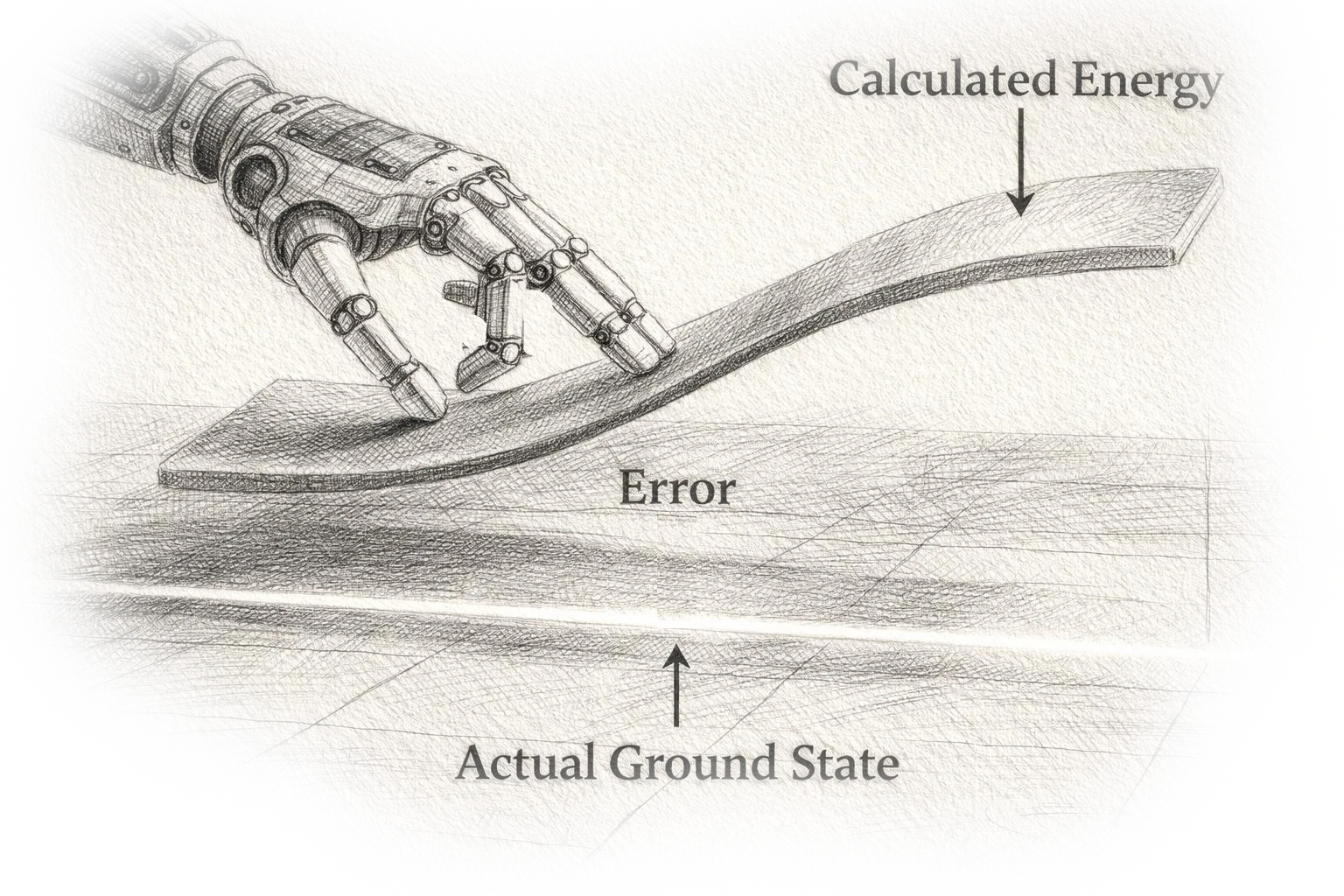
Learn more about Variational Quantum Eigensolver is based on the variational principle. This means that the energy value you calculate is mathematically proven to be an upper bound on the actual The **ground state** is the lowest possible energy state of a physical system, such as an atom or molecule. In this state, all particles occupy the lowest available energy levels allowed by quantum mechanics. Any higher-energy state is called an excited state.
Learn more about Ground State energy. In plain English: your answer will always be higher than or equal to the actual physical reality. You optimize to lower this value as much as possible, knowing that you can never accidentally go below the truth.
However, using The Variational Quantum Eigensolver (VQE) is a hybrid quantum-classical algorithm used to find the lowest energy (ground state) of a quantum system. It prepares a parameterized quantum state on a quantum computer, measures its energy, and uses a classical optimizer to adjust the parameters to minimize that energy. This approach reduces quantum hardware requirements by offloading the optimization loop to classical computation.
Learn more about Variational Quantum Eigensolver comes with risks that you need to manage:
- The barren plateau problem in quantum computing refers to regions in a quantum circuit’s parameter space where the **gradient of the cost function becomes exponentially small** as the number of qubits increases. This makes training variational quantum algorithms (like VQEs or QNNs) extremely difficult because optimization algorithms receive almost no useful signal to guide updates. It’s primarily caused by random circuit initialization and high circuit depth, leading to near-random output states.
Learn more about Barren Plateau If you design your circuit poorly, the mathematical landscape becomes flat. Your optimizer cannot find a A **gradient** is a vector that shows the direction and rate of the steepest increase of a function. Each component of the gradient is the **partial derivative** of the function with respect to one input variable. In optimization, it tells you how to adjust inputs to increase or decrease the function’s output most efficiently.
Learn more about Gradient to follow, and the algorithm will stall. - In quantum computing, measurement is the process of extracting classical information from a quantum state. It collapses a qubit’s superposition into one of its basis states (usually
or ), with probabilities determined by the amplitudes of those states. After measurement, the qubit’s state becomes definite, destroying the original superposition.
Learn more about Measurement overhead: To obtain a precise answer, you must run the circuit many times (shots) to estimate the energy.
How it works
Functionally, The Variational Quantum Eigensolver (VQE) is a hybrid quantum-classical algorithm used to find the lowest energy (ground state) of a quantum system. It prepares a parameterized quantum state on a quantum computer, measures its energy, and uses a classical optimizer to adjust the parameters to minimize that energy. This approach reduces quantum hardware requirements by offloading the optimization loop to classical computation.
Learn more about Variational Quantum Eigensolver is a classic Optimization is the process of finding the best possible solution to a problem within given constraints. It involves adjusting variables to minimize or maximize an objective function, such as cost, time, or efficiency. In simple terms, it’s about achieving the most effective outcome with the least waste or effort.
Learn more about Optimization scheme, but instead of minimizing a standard mathematical function, you minimize the output of a A **Parameterized Quantum Circuit (PQC)** is a quantum circuit where certain gate operations depend on adjustable parameters—typically real numbers representing rotation angles. These parameters are tuned (often by classical optimization) to perform a specific task, such as minimizing a cost function. PQCs are central to **variational quantum algorithms**, where quantum computation provides state preparation and measurement, and a classical computer optimizes the parameters.
Learn more about Parameterized Quantum Circuit (A **Parameterized Quantum Circuit (PQC)** is a quantum circuit where certain gate operations depend on adjustable parameters—typically real numbers representing rotation angles. These parameters are tuned (often by classical optimization) to perform a specific task, such as minimizing a cost function. PQCs are central to **variational quantum algorithms**, where quantum computation provides state preparation and measurement, and a classical computer optimizes the parameters.
Learn more about Parameterized Quantum Circuit You coordinate a loop between the quantum and classical processors, with each part solving a specific obstacle.
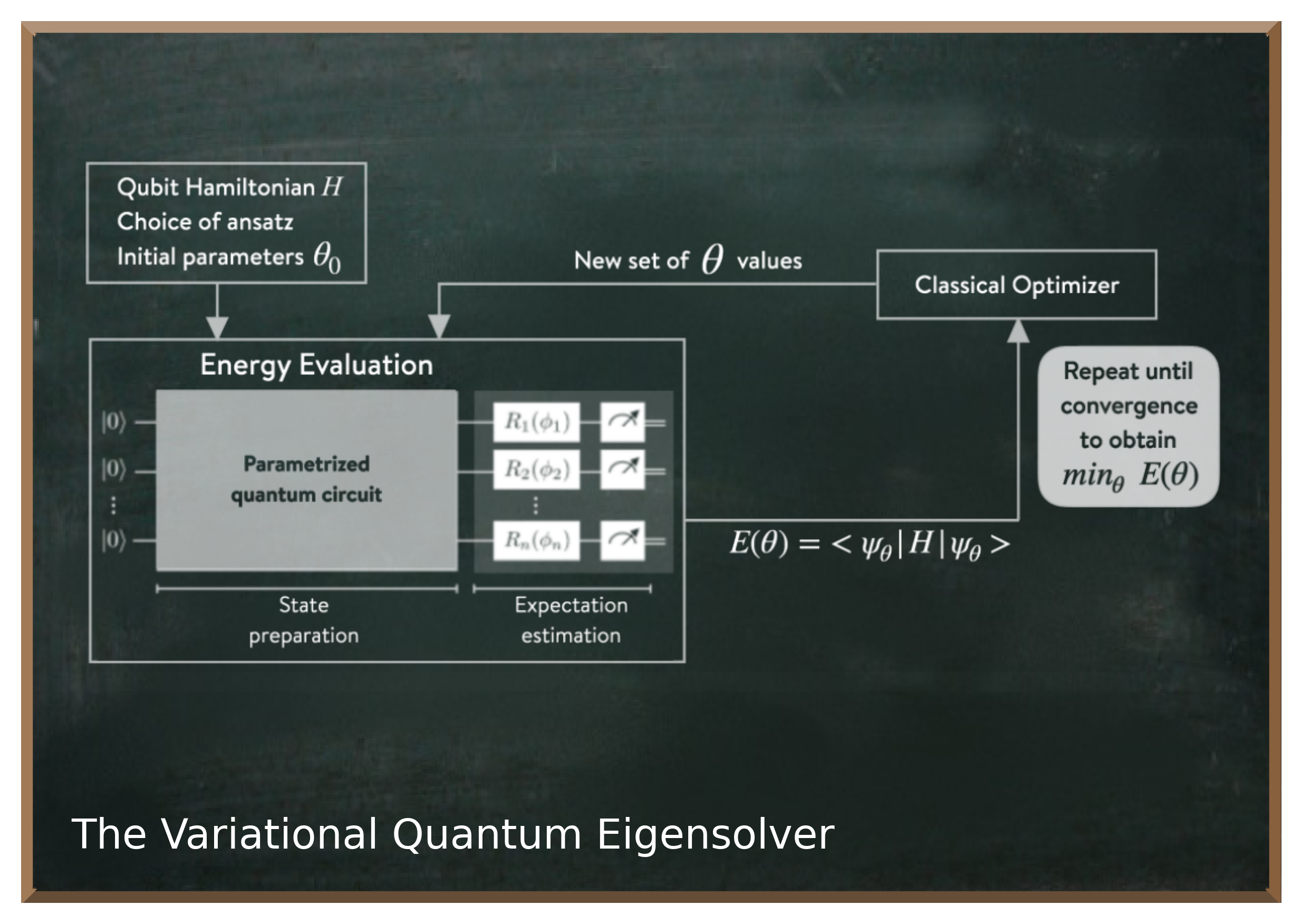
Step 1: The In quantum computing, a Hamiltonian is the operator (think “energy rulebook”) that determines how a quantum system evolves over time and which states are energetically favored. Practically, you define or engineer a Hamiltonian so that evolving the system (or finding its lowest-energy state) performs a computation—e.g., simulating molecules/materials or solving optimization problems by encoding the answer in the ground state. Quantum algorithms like Hamiltonian simulation and variational/annealing methods use the Hamiltonian as the central object to implement and control the computation.
Learn more about Hamiltonian operator (
Step 2: The Ansatz (
Learn more about Quantum State as a solution candidate to test. Since you cannot check every possible state, you define a parameterized circuit called an ansatz. This circuit,
Step 3: Energy estimation You run the A quantum circuit is a sequence of quantum gates applied to qubits, representing the operations in a quantum computation. Each gate changes the qubits’ state using quantum mechanics principles like superposition and entanglement. The final qubit states, when measured, yield the circuit’s computational result probabilistically.
Learn more about Quantum Circuit and measure the The expectation value is the average result you'd get if you repeated a measurement of a quantity many times under identical conditions. Mathematically, it’s the weighted average of all possible outcomes, where each outcome is weighted by its probability. In quantum mechanics, it represents the average value of an observable calculated from the wavefunction.
Learn more about Expectation Value You combine these In quantum computing, measurement is the process of extracting classical information from a quantum state. It collapses a qubit’s superposition into one of its basis states (usually
Learn more about Measurement to calculate the average energy by
Learn more about Cost Function The Accuracy is the proportion of correctly predicted examples (both true positives and true negatives) out of all examples. It’s calculated as correct predictions divided by total predictions. It works well when classes are balanced, but can be misleading if one class dominates.
Learn more about Accuracy of this number depends entirely on how many trials (shots) you perform.
Step 4: Classical Optimization is the process of finding the best possible solution to a problem within given constraints. It involves adjusting variables to minimize or maximize an objective function, such as cost, time, or efficiency. In simple terms, it’s about achieving the most effective outcome with the least waste or effort.
Learn more about Optimization You enter the estimated energy
Learn more about Simultaneous Perturbation Stochastic Approximation The optimizer calculates new parameters
Practical applications as strategic decisions
The The Variational Quantum Eigensolver (VQE) is a hybrid quantum-classical algorithm used to find the lowest energy (ground state) of a quantum system. It prepares a parameterized quantum state on a quantum computer, measures its energy, and uses a classical optimizer to adjust the parameters to minimize that energy. This approach reduces quantum hardware requirements by offloading the optimization loop to classical computation.
Learn more about Variational Quantum Eigensolver uses only one A quantum circuit is a sequence of quantum gates applied to qubits, representing the operations in a quantum computation. Each gate changes the qubits’ state using quantum mechanics principles like superposition and entanglement. The final qubit states, when measured, yield the circuit’s computational result probabilistically.
Learn more about Quantum Circuit (the An Ansatz is a chosen form or structure of a quantum state (often parameterized) used as a starting point for algorithms like the Variational Quantum Eigensolver. It defines how qubits are entangled and rotated, and its parameters are optimized to approximate the solution to a problem. The quality of the Ansatz directly affects the accuracy and efficiency of the computation.
Learn more about Ansatz to calculate the energy level of a candidate solution. So where does the Quantum advantage is the point where a quantum computer performs a specific task faster or more efficiently than the best possible classical computer. It doesn’t mean quantum computers are universally better—just that they outperform classical ones for that task. The first demonstrations (e.g., Google’s 2019 Sycamore experiment) showed speedups for highly specialized problems, not yet for practical applications.
Learn more about Quantum Advantage actually come from? If the classical computer performs the Optimization is the process of finding the best possible solution to a problem within given constraints. It involves adjusting variables to minimize or maximize an objective function, such as cost, time, or efficiency. In simple terms, it’s about achieving the most effective outcome with the least waste or effort.
Learn more about Optimization why use a A quantum computer is typically a large, highly controlled system kept at near-absolute-zero temperatures to preserve quantum behavior. It contains a processor with qubits—often made from superconducting circuits, trapped ions, or photons—manipulated by microwaves, lasers, or magnetic fields. Surrounding systems handle cooling, error correction, and control electronics to maintain quantum coherence and read out results.
Learn more about Quantum Computer at all?

The advantage lies exclusively in the areas of storage and representation. To represent a complex, highly entangled molecule classically, you have to store a list of numbers (a A vector is a mathematical object that has both magnitude (size) and direction. It’s often represented as an arrow or as an ordered list of numbers (components) that describe its position in space, such as
Learn more about Vector that grows exponentially with the size of the molecule. Even with a medium-sized molecule, the working memory is immediately exhausted. A A quantum computer is typically a large, highly controlled system kept at near-absolute-zero temperatures to preserve quantum behavior. It contains a processor with qubits—often made from superconducting circuits, trapped ions, or photons—manipulated by microwaves, lasers, or magnetic fields. Surrounding systems handle cooling, error correction, and control electronics to maintain quantum coherence and read out results.
Learn more about Quantum Computer does not store this list; it is the state. This approach allows you to investigate these complex, entangled states with a small number of A qubit is the basic unit of quantum information, representing a superposition of 0 and 1 states.
Learn more about Quantum Bit thus circumventing the memory limit that classical computers fail to meet.
Quantum chemistry (The **ground state** is the lowest possible energy state of a physical system, such as an atom or molecule. In this state, all particles occupy the lowest available energy levels allowed by quantum mechanics. Any higher-energy state is called an excited state.
Learn more about Ground State This is the most common area of application because electronic structures can be naturally mapped onto A qubit is the basic unit of quantum information, representing a superposition of 0 and 1 states.
Learn more about Quantum Bit Classical computers fail due to the memory requirements for large electron clouds. The Variational Quantum Eigensolver (VQE) is a hybrid quantum-classical algorithm used to find the lowest energy (ground state) of a quantum system. It prepares a parameterized quantum state on a quantum computer, measures its energy, and uses a classical optimizer to adjust the parameters to minimize that energy. This approach reduces quantum hardware requirements by offloading the optimization loop to classical computation.
Learn more about Variational Quantum Eigensolver outsources this state storage problem to the QPU.
Spin models (magnetism) You use The Variational Quantum Eigensolver (VQE) is a hybrid quantum-classical algorithm used to find the lowest energy (ground state) of a quantum system. It prepares a parameterized quantum state on a quantum computer, measures its energy, and uses a classical optimizer to adjust the parameters to minimize that energy. This approach reduces quantum hardware requirements by offloading the optimization loop to classical computation.
Learn more about Variational Quantum Eigensolver for models such as Hubbard or Heisenberg lattices. Hardware connectivity often mirrors the lattice structure, allowing you to use efficient ansätze that capture magnetic properties that classical simulations may overlook.
Hardware benchmarking Sometimes you run The Variational Quantum Eigensolver (VQE) is a hybrid quantum-classical algorithm used to find the lowest energy (ground state) of a quantum system. It prepares a parameterized quantum state on a quantum computer, measures its energy, and uses a classical optimizer to adjust the parameters to minimize that energy. This approach reduces quantum hardware requirements by offloading the optimization loop to classical computation.
Learn more about Variational Quantum Eigensolver not to find an answer, but to test the machine. Because The Variational Quantum Eigensolver (VQE) is a hybrid quantum-classical algorithm used to find the lowest energy (ground state) of a quantum system. It prepares a parameterized quantum state on a quantum computer, measures its energy, and uses a classical optimizer to adjust the parameters to minimize that energy. This approach reduces quantum hardware requirements by offloading the optimization loop to classical computation.
Learn more about Variational Quantum Eigensolver is sensitive to Noise
Learn more about Noise errors, and the stability of the optimizer, it serves as a rigorous stress test for your system.
Code Example
? provides a complete example of how to use the The Variational Quantum Eigensolver (VQE) is a hybrid quantum-classical algorithm used to find the lowest energy (ground state) of a quantum system. It prepares a parameterized quantum state on a quantum computer, measures its energy, and uses a classical optimizer to adjust the parameters to minimize that energy. This approach reduces quantum hardware requirements by offloading the optimization loop to classical computation.
Learn more about Variational Quantum Eigensolver. We use Qiskit is an open-source Python framework for programming and simulating quantum computers. It lets users create quantum circuits, run them on real quantum hardware or simulators, and analyze the results. Essentially, it bridges high-level quantum algorithms with low-level hardware execution.
Learn more about Qiskit implementation of this algorithm for convenience.
What you control here:
- The
SparsePauliOplet's you . That is the object whose ground state we aim to compute. - We use the predefined
TwoLocalas our . Here, we define the Circuit depth in quantum computing is the number of layers of quantum gates that must be applied sequentially, where gates acting on different qubits in parallel count as one layer. It measures how long a quantum computation takes, assuming gates in the same layer happen simultaneously. Lower depth is crucial because qubits lose coherence over time, so deep circuits are more error-prone.
Learn more about Circuit Depth You must balance the need for Entanglement is a quantum phenomenon where two or more particles become correlated so that measuring one instantly determines the state of the other, no matter how far apart they are. This correlation arises because their quantum states are linked as a single system, not as independent parts. It doesn’t allow faster-than-light communication but shows that quantum systems can share information in ways classical physics can’t explain.
Learn more about Entanglement against the Noise
Learn more about Noise introduced by deeper circuits. - Finally, we the Optimization is the process of finding the best possible solution to a problem within given constraints. It involves adjusting variables to minimize or maximize an objective function, such as cost, time, or efficiency. In simple terms, it’s about achieving the most effective outcome with the least waste or effort.
Learn more about Optimization strategy. In this example, we useSimultaneous Perturbation Stochastic Approximation (SPSA) is an optimization method that estimates the gradient of an objective function using only two function evaluations per iteration, regardless of the problem’s dimension. It does this by randomly perturbing all parameters simultaneously and using the difference in the resulting function values to approximate the gradient. SPSA is efficient for noisy or high-dimensional problems where computing exact or finite-difference gradients is costly..
Learn more about Simultaneous Perturbation Stochastic Approximation
When you run this code, you will get the following output depicted in ?, which shows the estimated ground energy and the parameter values that lead to this energy.
The The Variational Quantum Eigensolver (VQE) is a hybrid quantum-classical algorithm used to find the lowest energy (ground state) of a quantum system. It prepares a parameterized quantum state on a quantum computer, measures its energy, and uses a classical optimizer to adjust the parameters to minimize that energy. This approach reduces quantum hardware requirements by offloading the optimization loop to classical computation.
Learn more about Variational Quantum Eigensolver is not a one-size-fits-all problem solver. It only shines when the problem at hand exhibits non-classical correlations between its components. You frequently find this when modelling a system that adheres to (or is at least affected by) the laws of quantum physics, like a molecule. But these correlations do not exist so often in the macro-world we observe.
Furthermore, the The Variational Quantum Eigensolver (VQE) is a hybrid quantum-classical algorithm used to find the lowest energy (ground state) of a quantum system. It prepares a parameterized quantum state on a quantum computer, measures its energy, and uses a classical optimizer to adjust the parameters to minimize that energy. This approach reduces quantum hardware requirements by offloading the optimization loop to classical computation.
Learn more about Variational Quantum Eigensolver is not a precise solver. It is a A heuristic is a simplified rule or mental shortcut used to make decisions or solve problems quickly when a full analysis would be too slow or complex. It sacrifices some accuracy or optimality for efficiency and practicality. In computing and AI, heuristics guide algorithms toward good-enough solutions when exact methods are too costly.
Learn more about Heuristic Without careful design, the cost of In quantum computing, measurement is the process of extracting classical information from a quantum state. It collapses a qubit’s superposition into one of its basis states (usually
Learn more about Measurement can make it slower than classical methods. It only offers an advantage if the problem is so chemically complex that a classical computer literally cannot perform the simulation, but so small that a Noisy Intermediate-Scale Quantum refers to the current generation of quantum devices that have enough qubits to run non-trivial algorithms but are still small and error-prone, limiting their reliability and scalability.
Learn more about Noisy Intermediate-Scale Quantum device can handle the Circuit depth in quantum computing is the number of layers of quantum gates that must be applied sequentially, where gates acting on different qubits in parallel count as one layer. It measures how long a quantum computation takes, assuming gates in the same layer happen simultaneously. Lower depth is crucial because qubits lose coherence over time, so deep circuits are more error-prone.
Learn more about Circuit Depth
You now understand the mechanism. The Variational Quantum Eigensolver (VQE) is a hybrid quantum-classical algorithm used to find the lowest energy (ground state) of a quantum system. It prepares a parameterized quantum state on a quantum computer, measures its energy, and uses a classical optimizer to adjust the parameters to minimize that energy. This approach reduces quantum hardware requirements by offloading the optimization loop to classical computation.
Learn more about Variational Quantum Eigensolver is not a push-button solution. It is an engineering challenge where you balance Circuit depth in quantum computing is the number of layers of quantum gates that must be applied sequentially, where gates acting on different qubits in parallel count as one layer. It measures how long a quantum computation takes, assuming gates in the same layer happen simultaneously. Lower depth is crucial because qubits lose coherence over time, so deep circuits are more error-prone.
Learn more about Circuit Depth In quantum computing, measurement is the process of extracting classical information from a quantum state. It collapses a qubit’s superposition into one of its basis states (usually
Learn more about Measurement cost, and optimizer stability to extract data from imperfect hardware.