What's The Difference Between Learning Values And Learning Relationships?
Relationships carry information that single facts do not, and they are inherently harder to extract.
Knowing isolated facts doesn't tell you how they fit together. Learn why many problems depend on relationships and why these are harder to uncover than individual values.

You can carefully examine a system and still overlook the essentials.
You look at one output. You learn one fact.
You look at another output. You learn another fact.
And yet the question that interests you may remain unanswered. There is obviously a gap. If you don't clearly recognize this, nothing about will make sense later on.
So let's be clear about this.
A local observation tells you a value. In contrast, a global property tells you how values relate to each other. These are not the same types of knowledge. A value exists in one place. A relationship exists across multiple places. You can't reduce one to the other through cleverness.
Why can't I do that?
If a global property depends on local values, it should be sufficient to learn those values, no? If you know all the parts, how could you possibly miss the whole? So why not just try a few results and deduce the rest from them?
This instinct is reasonable. However, it fails for a specific reason that has nothing to do with
Local questions and global questions are different
Ask yourself what kind of question you are asking.
A local question sounds something like this: What is the output when input is entered?
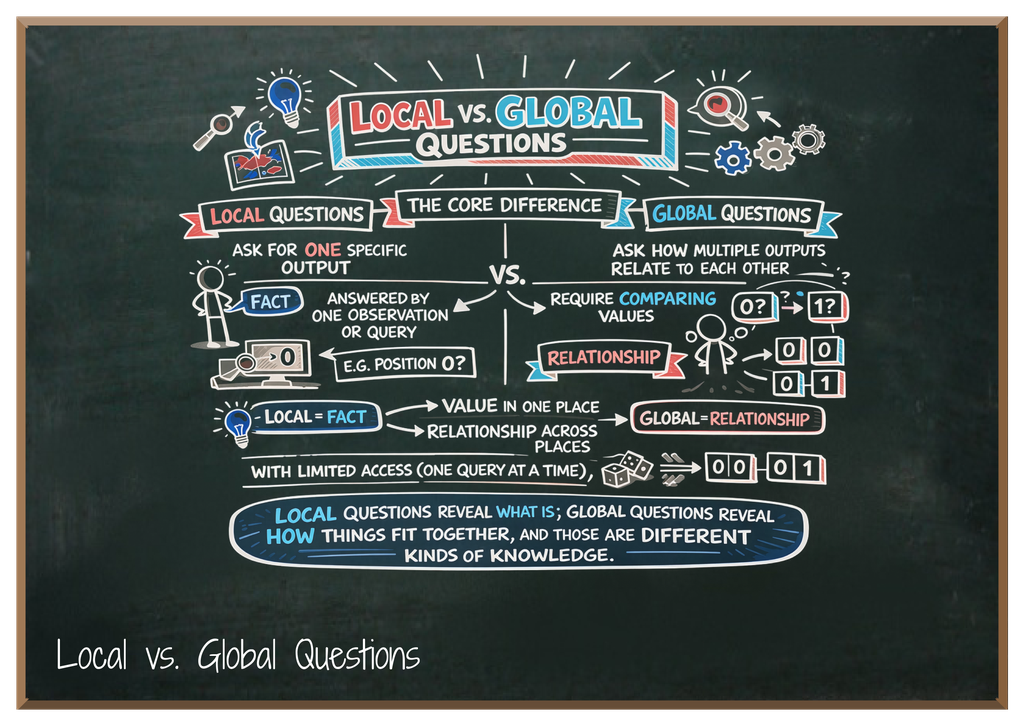
A global question, on the other hand, sounds something like this: How do the outputs compare to each other?
The first question can be answered by a single interaction with the system. The second question usually cannot.
Let's consider a simple system with two positions, and .
You can ask what comes out at position . And you can ask what comes out at position .
These are local questions.
But perhaps you are interested in the following instead: Are the two values the same or different?
This question is not about the individual values. It is about the relationship between them.
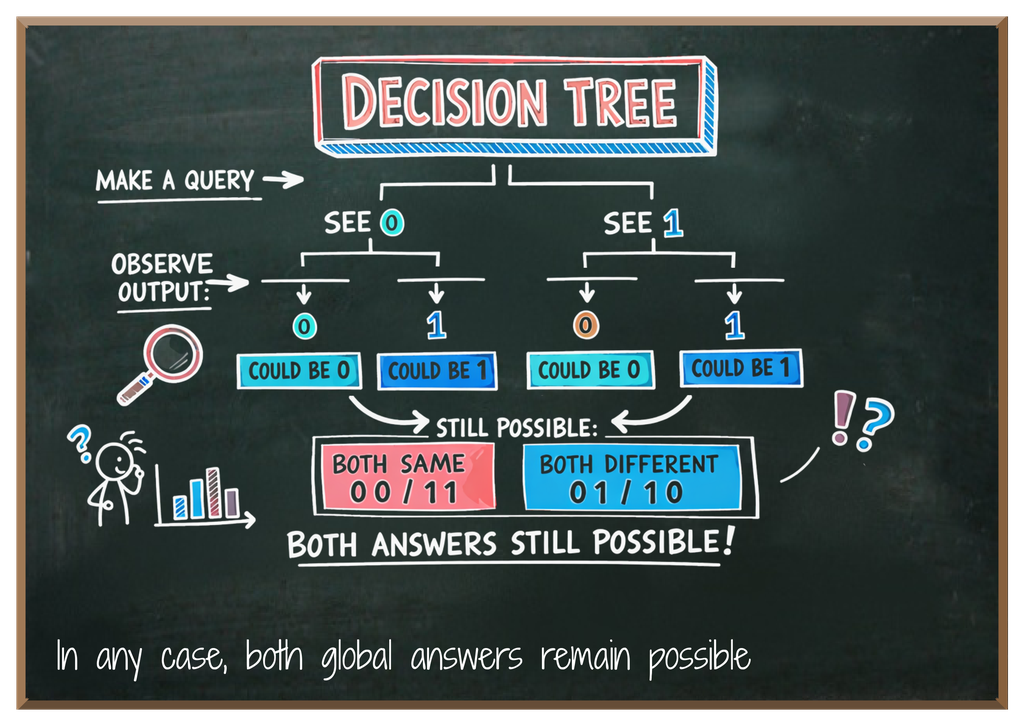
And even though the answer depends entirely on the two local values, you cannot answer this question by looking at only one item.
This distinction is fundamental in computer science and decision theory. It always arises when problems are defined by characteristics rather than by data.
Limited access makes relationships expensive
Now let's assume that you don't have full access to the system.
Read next: